
Think a robot is running your portfolio with no rules?
Think again.
Robo-advisors usually register as Registered Investment Advisers (RIAs), owe a fiduciary duty, file Form ADV, and use SIPC-member custodians so your securities stay separate.
Uninvested cash can get FDIC coverage, and cybersecurity, SOC audits, and algorithm governance add extra layers.
But SIPC and FDIC don’t protect you from market drops or a flawed model.
This post walks through the rules, real protections, and the gaps so you know what actually keeps your money safe.
Key Foundations of Robo Advisor Safety and Regulatory Protections
Robo-advisors work under the same legal rules as traditional financial advisors. When a robo-advisor manages your money, it usually registers as a Registered Investment Adviser (RIA) with the SEC or state regulators. Registration brings fiduciary duty, which means the firm must act in your best interest. They file Form ADV, a public document showing services, fees, conflicts, and where your money lives. FINRA watches over broker-dealers that handle trades or custody. State regulators cover smaller advisers. All of this oversight pushes robo-advisors to follow core rules: know what you’re doing, be honest, make sure recommendations fit.
Insurance adds another layer. SIPC coverage protects accounts up to $500,000 if a brokerage fails, with $250,000 of that for cash. FDIC insurance kicks in when a robo-advisor parks uninvested cash at a partner bank, covering up to $250,000 per person per bank. Custodial segregation keeps your investments separate from the robo-advisor’s own books, so if the company goes bankrupt, your holdings stay safe. But SIPC and FDIC won’t cover market losses, bad advice, or algorithm mistakes. Those risks are on you.
Safety runs deeper than insurance and paperwork. Cybersecurity, algorithm controls, audits, and vendor oversight protect your data, your login, and the decisions driving your portfolio. The sections below break down each area so you can check which protections actually matter.
- SEC registration: RIA status and public Form ADV filings you can look up yourself.
- SIPC coverage: Up to $500,000 per customer if the brokerage custodian collapses, including $250,000 for cash.
- FDIC coverage: Up to $250,000 per person per bank for cash swept into partner banks.
- Custody segregation: Your assets sit at independent, SIPC-member custodians, not mixed with the adviser’s money.
- Fiduciary oversight: Legal duty to put your interests first, disclose conflicts, and recommend suitable investments.
Regulatory Bodies Governing Automated Investment Platforms
The SEC oversees robo-advisors registered as RIAs. These firms owe fiduciary duty, keep detailed records, and face periodic SEC exams. State regulators handle smaller RIAs managing under $100 million. FINRA steps in when a robo-advisor works with a broker-dealer for trades or custody. Each regulator checks suitability, fee disclosure, conflict handling, and how you’re kept in the loop. When software makes investment calls, regulators treat it like any other adviser. The platform must justify recommendations, document client profiles, and show portfolios match stated risk levels.
Automation changes things. Regulators want firms to explain how algorithms generate advice, document model logic, and test for bias or failures. The SEC published guidance saying automated systems need auditable records, human oversight, and version control so examiners can reconstruct old advice. FINRA reviews algorithm governance when broker-dealers lean on automation. State regulators follow similar lines. Robo-advisors face the traditional rulebook plus extra accountability for the code and data behind each portfolio.
Filing and Disclosure Requirements
Form ADV is the main disclosure every RIA files with the SEC or state regulators and updates at least once a year. Part 1 covers registration details, assets managed, and any disciplinary history. Part 2 (the brochure) explains services, fees, conflicts, custody setups, and who runs the tech. Robo-advisors disclose how algorithms decide asset allocation, any model limits, and who operates the technology. Fee schedules must be clear. Most charge a percentage of assets under management (often 0.25% to 0.50% annually), and that number appears in Form ADV alongside partner fees or platform charges.
Suitability starts with a questionnaire grabbing your age, income, goals, time horizon, and risk comfort. The robo-advisor maps your answers to a portfolio model. Regulators want documentation showing that mapping makes sense and stays consistent. If the algorithm changes, the adviser explains why and files an updated Form ADV when the change is material. Algorithm explainability means the firm can walk regulators through how inputs create outputs, show backtested performance during past market chaos, and prove the model treats similar clients the same way. Regulators also expect monitoring for drift, when live results stray from expectations, plus quick fixes when errors pop up.
SIPC and FDIC Protections for Robo Advisor Accounts

SIPC exists to restore missing securities and cash when a brokerage firm fails or steals customer assets. Coverage caps at $500,000 per customer, with a $250,000 sub-limit for cash. SIPC doesn’t insure you against market drops, poor investment choices, or algorithm screw-ups. It only activates when the custodian holding your assets goes insolvent or assets vanish due to brokerage-level fraud. Most robo-advisors custody client assets at large firms that are SIPC members (think Apex Clearing, Charles Schwab, Fidelity). That setup separates your investments from the robo-advisor’s balance sheet. Even if the robo-advisor shuts down, your holdings stay put at the custodian.
FDIC insurance covers cash deposits at FDIC-insured banks, up to $250,000 per person per institution. When a robo-advisor sweeps uninvested cash into a partner bank, that cash gets FDIC coverage within the limit. If your cash exceeds $250,000, the robo-advisor might spread it across multiple partner banks to multiply coverage (program banks). Stocks, ETFs, bonds, and mutual funds in your brokerage account never get FDIC coverage because they’re securities, not deposits. FDIC and SIPC work separately: SIPC handles brokerage failures, FDIC handles bank failures.
Gaps exist. If your account holds more than $500,000 in securities, only the first $500,000 is SIPC-protected. Market crashes, algorithm errors, unauthorized trades from weak account security, and fraud outside brokerage insurance are your problem. Some robo-advisors buy excess insurance above SIPC limits, but policies vary by provider and situation. Always verify the custodian’s SIPC membership and confirm FDIC details for any cash sweep.
| Coverage Type | What It Protects | Limit |
|---|---|---|
| SIPC | Missing or stolen securities and cash if the brokerage firm fails | $500,000 per customer (including up to $250,000 cash) |
| FDIC | Cash deposits at FDIC-insured banks if the bank fails | $250,000 per depositor per bank |
| Market Loss | Not covered by SIPC or FDIC | No insurance |
| Algorithm Error | Not covered by SIPC or FDIC (potential legal claim against adviser) | No insurance |
Cybersecurity Standards and Data Protection in Automated Advisory Platforms

Robo-advisors handle sensitive stuff: your Social Security number, bank details, balances, transaction history. Cybersecurity controls aren’t optional. Regulators expect encryption at rest (data sitting on servers) and in transit (data moving between your device and the platform). AES-256 is common for storage. TLS 1.2 or higher secures web connections. Multi-factor authentication (MFA) is standard now: you provide a password plus a code sent to your phone to log in. Platforms skipping MFA or using weak password rules signal sloppy security.
Beyond encryption and MFA, robo-advisors run regular vulnerability scans and penetration tests. Security firms try to break in and report what they find. Many platforms get annual SOC 1 or SOC 2 Type II audits, independent reviews checking controls around data security, availability, confidentiality, and processing. SOC 2 Type II tests controls over time, not just once, so it’s stronger proof. Vendors (cloud hosts, identity checkers, custodians) must meet security standards too. Robo-advisors vet third parties, review their SOC reports, and write breach notification and liability clauses into contracts. Incident response plans spell out how the firm detects, contains, and discloses a breach. Cyber insurance covers some costs but can’t undo the reputation or legal damage from stolen customer data.
Key cybersecurity controls to expect:
- Encryption: AES-256 for stored data, TLS 1.2+ for data moving between your browser and the platform.
- Multi-factor authentication: Required second login step using another device or biometric, cutting account takeover risk.
- SOC audits: Annual SOC 1 or SOC 2 Type II reports verifying security controls and operational procedures.
- Penetration testing: Regular third-party break-in attempts, with fixes applied before the next cycle.
- Vendor security vetting: Checking cloud providers, custodians, and data processors to lock down the supply chain.
- Breach response: Documented playbooks for detecting, containing, notifying regulators and customers, and recovering from security incidents.
Algorithm Governance, Model Risk, and Portfolio Construction Controls

Automated advice starts with an algorithm mapping your risk profile to a portfolio. Regulators want that algorithm explainable, reproducible, and auditable. Explainability means the firm can describe in plain terms how inputs (age, goals, risk tolerance) produce outputs (a specific ETF mix). Reproducibility means the same inputs twice should give the same portfolio. Auditability means the firm logs every portfolio decision, timestamps model versions, and keeps records available for review. Without these controls, regulators and investors can’t verify advice is suitable or consistent.
Model validation is separate. Before launching a new algorithm or updating one, the robo-advisor backtests it against historical markets to estimate how portfolios would’ve performed in past downturns. Stress testing throws extreme but plausible scenarios at the model (sudden rate spike, flash crash, liquidity freeze) to find weak spots. Independent model validation, often by a different team or outside party, reviews code, assumptions, data quality, and suitability mappings. If the model drifts (live results diverge from backtests or expected behavior), the firm investigates and recalibrates. Human oversight stays essential: compliance officers, portfolio managers, or risk teams review model outputs, spot outliers, and approve changes before customer accounts see them.
Suitability mapping links your questionnaire to your portfolio. The robo-advisor defines risk buckets (conservative, moderate, aggressive) and assigns asset allocations to each. Regulators check that these mappings are reasonable and that the firm adjusts them when markets or fund options change. Data quality controls make sure questionnaire answers are validated (no impossible ages or blank answers) and that market data feeding the algorithm is accurate and timely. Version control tracks every code change, so examiners can trace advice given on a specific date back to the exact model version and data set in play.
Documenting and Auditing Algorithm Decisions
Regulators expect robo-advisors to keep audit logs recording portfolio recommendations, rebalancing triggers, tax-loss harvesting trades, and the model version behind each action. Logs must be timestamped and tamper-resistant. During an SEC exam, the firm should reproduce advice given to any client on any date by re-running the same inputs and model version. Testing scenarios are part of compliance: the firm regularly runs sample profiles through the algorithm to confirm it still behaves as designed. Change management procedures require sign-off before deploying new code. Rollback plans let the firm revert to a previous version if a deployment causes problems. All this documentation forms the evidence regulators use to verify automated advice meets fiduciary and suitability standards.
How Robo-Advisors Are Audited, Monitored, and Examined

Robo-advisors face the same exam cycles as traditional RIAs. The SEC runs risk-based exams every few years, reviewing compliance manuals, client files, fee calculations, custody controls, and advertising. Examiners pull sample portfolios, test whether the algorithm applied the stated method, and check that disclosures match actual practice. FINRA examines broker-dealer functions if the robo-advisor or its custodian operates as one. State regulators do similar reviews for smaller advisers. Internal compliance audits run more often (quarterly or annually), led by a Chief Compliance Officer reporting to senior management or the board.
SOC reports give ongoing operational proof. A SOC 2 Type II audit tests controls over a period (often six to twelve months) and issues an opinion on whether controls worked effectively. SOC 1 reports focus on financial reporting controls relevant to the custodian or service provider. Vendor audits push oversight to third parties: the robo-advisor reviews custodians’, cloud providers’, and data processors’ own SOC reports and security certifications. Business continuity and disaster recovery drills test whether the platform can bounce back from outages, cyberattacks, or data loss. Incident response exercises simulate breaches to verify notification, containment, and forensic procedures actually work.
Core audit and monitoring pieces:
- SEC examinations: Periodic risk-based reviews of compliance programs, client files, fee practices, and algorithm documentation.
- Internal compliance audits: Quarterly or annual reviews led by the CCO, covering trading, disclosures, conflicts, and model governance.
- SOC 2 Type II reports: Independent check that security and operational controls function effectively over time.
- Vendor security assessments: Ongoing monitoring of third-party service providers’ own audits and certifications.
- Incident response testing: Simulated breach or outage drills confirming detection, containment, notification, and recovery procedures work.
Comparing Safety Standards: Robo-Advisors vs. Traditional Human Advisors

When both register as RIAs, robo-advisors and human advisors owe the same fiduciary duty and face the same core disclosure, suitability, and exam requirements. Differences show up in execution. Human advisors lean on relationships, manual portfolio reviews, and subjective calls. Robo-advisors use algorithms, automated rebalancing, and digital onboarding. Regulators pile extra algorithm governance expectations on robo-advisors (model documentation, backtesting, version control, audit trails) because automation runs at scale without real-time human review of every decision.
Fee structures often split. Robo-advisors typically charge 0.25% to 0.50% of assets under management annually, lower than many human advisors charging 1% or more. Lower fees reflect automation efficiencies but also mean less personal service. Human advisors handle complex tax situations, estate planning, and behavioral coaching. Robo-advisors manage standard portfolios well but may escalate unusual cases to human support. Cybersecurity and IT controls matter more for robo-advisors because breaches hit thousands of accounts at once, while human advisors face operational risk through email phishing or document fumbles but at smaller scale.
Transparency and disclosure sometimes favor robo-advisors. Algorithm-driven advice produces consistent, documented recommendations easier to audit. Human advice varies by advisor mood, experience, or personal bias, and proving suitability after the fact gets harder. But robo-advisors give up flexibility: the algorithm can’t easily override its own rules when your situation is unique. Hybrid models (automated portfolios with on-demand human advisors) try to combine algorithm efficiency and human judgment for edge cases.
- Regulatory parity: Both must register, disclose fees and conflicts, maintain custody controls, and act in client best interests when serving as RIAs.
- Algorithm vs. human oversight: Robo-advisors document model logic and version control. Human advisors document judgment and client conversations.
- Fee levels: Robo-advisors typically 0.25% to 0.50% AUM. Traditional advisors often 1% or higher, reflecting service scope and personalization.
- Scalability and risk: Robo-advisors handle thousands of accounts with identical processes, amplifying both efficiency and systemic impact of any error. Human advisors manage fewer clients with tailored but less auditable advice.
Common Safety Risks in Automated Investing and How Platforms Mitigate Them

Data breaches top the list. Robo-advisors hold Social Security numbers, bank routing details, account balances (prime targets for identity theft and fraud). Mitigation starts with encryption, MFA, and access controls limiting which employees and systems can view sensitive data. Regular penetration tests and vulnerability scans catch weaknesses before attackers do. Breach notification laws require firms to disclose incidents within specific timeframes. Cyber insurance helps cover forensic, legal, and notification costs.
Algorithm failures or biased models present a different threat. A coding error might allocate portfolios wrong. A data feed malfunction could trigger mass rebalancing. A biased training dataset might steer certain demographics toward unsuitable investments. Robo-advisors fight these risks through stress testing, human oversight of outliers, version control, and rollback capabilities. If a deployment causes unexpected trades, the firm can revert to the prior model version and investigate. Independent model validation catches logic errors and bias before they reach production. Monitoring dashboards alert compliance teams to drift or anomalies in real time.
Market losses and vendor risks round out the picture. SIPC and FDIC don’t cover investment losses from market downturns or poor asset allocation. That risk comes with investing. Robo-advisors manage it through diversification, risk profiling, and client disclosures, but they can’t eliminate it. Vendor outages (custodian’s trading platform goes down, cloud provider suffers an outage) can block account access or delay trades. Firms tackle vendor risk through due diligence, contractual SLAs, redundant systems, and backup plans. When a third-party failure hits, clear communication and rapid escalation to backup providers limit customer impact.
- Data breach: Encryption at rest and in transit, MFA, least-privilege access, penetration testing, SOC audits, cyber insurance, and incident response playbooks.
- Algorithm failure: Backtesting, stress testing, version control, independent model validation, human review of outliers, and rollback procedures for faulty deployments.
- Market loss: Diversification, risk profiling, suitability disclosures, and client education that SIPC/FDIC don’t insure against value declines.
- Biased models: Bias testing during development, diverse training data, independent validation, and ongoing monitoring for disparate outcomes across demographic groups.
- Vendor outages: Vendor due diligence, contractual SLAs, backup custodians or service providers, and business continuity plans tested through regular drills.
- Custodial failure beyond insurance: Asset segregation at SIPC-member custodians, excess insurance policies (where available), and diversification across multiple custodians for very large accounts.
How Investors Can Verify a Robo-Advisor’s Safety Credentials
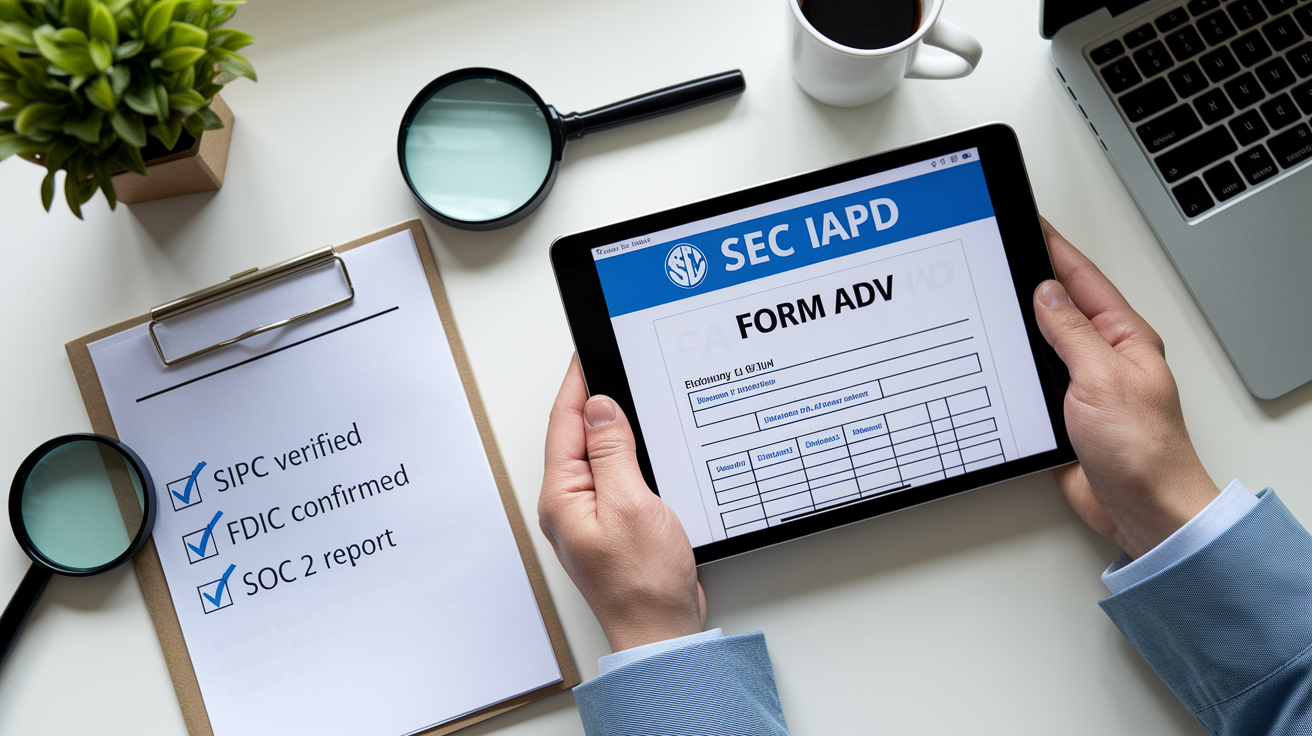
Start with Form ADV. Every SEC-registered RIA files it on the SEC’s Investment Adviser Public Disclosure (IAPD) website. Search by firm name, read Part 2 for services and fees, check Part 1 for disciplinary history and assets under management. If the firm has regulatory actions or customer complaints, details show up in the filing. State-registered advisers file with state securities regulators. Many states offer online search tools. Confirm the robo-advisor is currently registered and disclosures match marketing claims.
Next, verify SIPC membership of the custodian. The robo-advisor should name its custodian in Form ADV or on its website. Visit SIPC.org and search the member directory to confirm the custodian is a member. Ask the robo-advisor for written confirmation of coverage limits and whether the firm carries excess insurance above the standard $500,000. For cash sweep accounts, confirm which banks hold your cash and that they’re FDIC-insured. The robo-advisor should disclose partner banks and the per-bank $250,000 limit. If your cash balance exceeds that, check whether the platform spreads balances across multiple banks to multiply coverage.
Request or locate security documentation. Many established robo-advisors publish security summaries on their websites or give SOC 2 reports to customers on request. Look for evidence of encryption, MFA, penetration testing, and third-party audits. Review the platform’s terms of service and privacy policy for data handling, breach notification procedures, and dispute resolution. Check whether the platform offers account alerts, login notifications, and user-controlled security settings like biometric login or device whitelisting. Test customer support by asking specific questions about SIPC coverage, algorithm governance, or how the firm handles a data breach. Strong answers point to a mature compliance culture.
- Verify SEC or state registration via IAPD or state securities regulator websites. Review Form ADV Part 2 for services, fees, conflicts, and disciplinary history.
- Confirm SIPC membership of the custodian using the SIPC.org member directory. Ask about excess insurance above the $500,000 limit.
- Identify FDIC partner banks and confirm cash balances stay within the $250,000 per-bank limit or spread across multiple banks for higher coverage.
- Request SOC 2 Type II reports or security summaries. Check the website for published security practices, encryption standards, and penetration testing frequency.
- Review the platform’s terms of service, privacy policy, and breach notification procedures. Confirm the firm uses MFA and offers account security features.
- Test escalation paths by contacting support with specific compliance questions. Firms with strong compliance give clear, documented answers.
- Check for hybrid support options: whether the platform offers access to human advisors for complex situations or disputes.
- Compare fee schedules against disclosed AUM percentages in Form ADV. Make sure no hidden charges appear in account statements.
Well-known robo-advisors like Betterment, Wealthfront, Vanguard Digital Advisor, and Schwab Intelligent Portfolios publish their custodian relationships (Betterment uses Apex Clearing, Wealthfront uses multiple custodians, Vanguard and Schwab custody assets in-house as SIPC members), provide security summaries on their websites, and maintain current Form ADV filings. Each undergoes regular SEC exams and third-party audits. When evaluating any platform, run the same checks no matter the brand. Regulatory filings and audit evidence matter more than marketing.
For additional context on assessing robo-advisor safety, see Are Robo-Advisors Safe?, which walks through SIPC and FDIC verification steps in detail.
Global and Cross-Border Regulation of Automated Investment Services
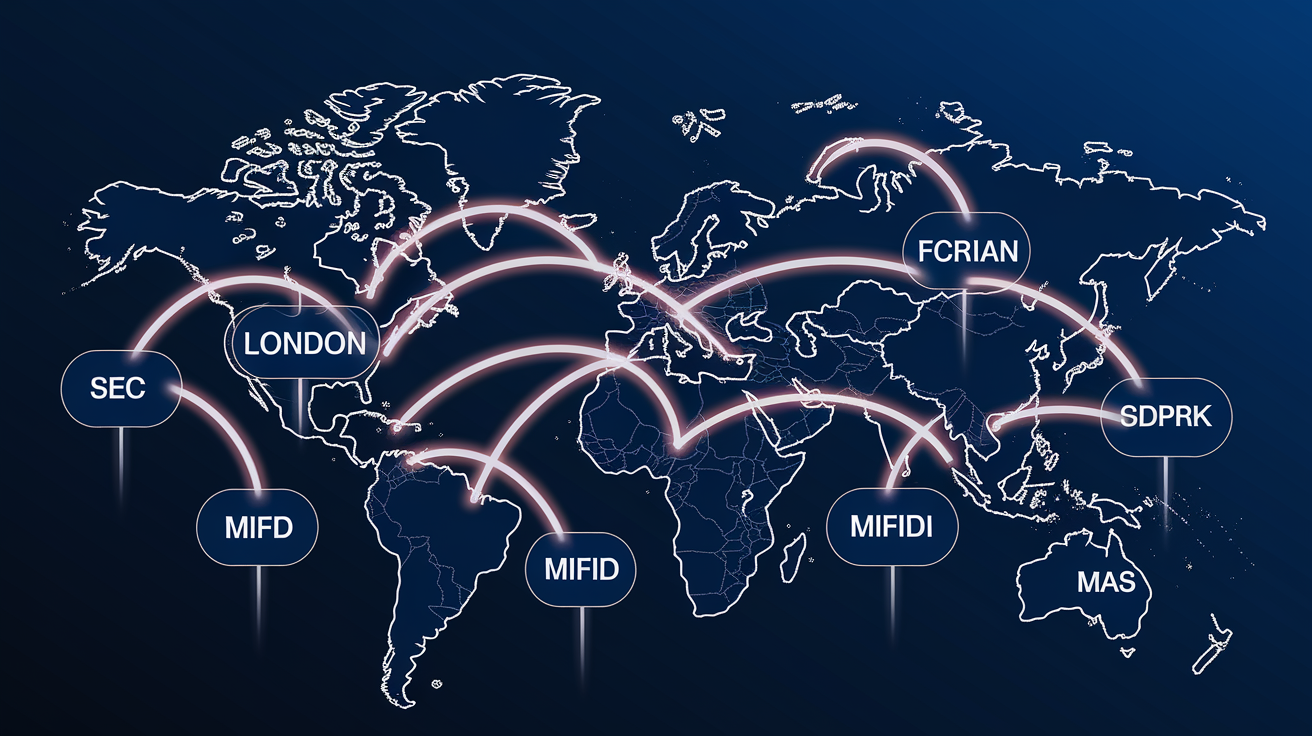
Robo-advisors operating across borders face a patchwork of regulatory regimes with limited alignment. In the United States, the SEC and FINRA set standards. In the European Union, MiFID II (Markets in Financial Instruments Directive) governs investment services and requires algorithm transparency, best execution, and suitability assessments similar to U.S. rules. The UK’s Financial Conduct Authority (FCA) applies comparable principles but with distinct reporting and capital requirements. Each jurisdiction defines “investment advice” differently, so a platform legal in one country may need extra licensing in another.
Data protection laws add complexity. The EU’s General Data Protection Regulation (GDPR) imposes strict rules on data collection, storage, cross-border transfer, and user consent. Platforms serving EU clients must appoint data protection officers, honor data deletion requests, and report breaches within 72 hours. California’s Consumer Privacy Act (CCPA) and similar state laws create overlapping but not identical obligations in the U.S. Data residency requirements (mandating customer data stay within a specific country or region) force robo-advisors to use local cloud providers or data centers, jacking up infrastructure costs and complicating disaster recovery. Know Your Customer (KYC) and Anti-Money Laundering (AML) rules vary by country, affecting onboarding speed and identity verification methods.
| Region | Primary Regulator(s) | Key Rules | Data & Privacy |
|---|---|---|---|
| United States | SEC, FINRA, State Regulators | RIA registration, Form ADV, fiduciary duty, algorithm governance, SIPC/FDIC protections | Sector-specific (financial privacy under Reg S-P); state laws like CCPA; no federal comprehensive data law |
| European Union | National regulators under MiFID II, ESMA coordination | MiFID II suitability, best execution, algorithm disclosure, cross-border passporting for EU firms | GDPR: strict consent, data transfer, breach notification (72 hours), data residency preferences |
| United Kingdom | Financial Conduct Authority (FCA) | FCA authorization, suitability, treating customers fairly, algorithm governance similar to MiFID II | UK GDPR post-Brexit (closely mirrors EU GDPR); separate adequacy determinations for data transfers |
| Asia-Pacific (examples: Singapore, Australia) | MAS (Singapore), ASIC (Australia) | Licensing, disclosure, algorithm explainability; varied approaches to robo-advice regulation and sandboxes | Country-specific data protection laws (Singapore PDPA, Australia Privacy Act); limited cross-border coordination |
Final Words
We walked straight through who watches robo‑advisors, what filings they make, and how custody and audits keep client assets separate and tracked. We also explained cybersecurity, algorithm governance, and how exams and SOC reports fit into oversight.
SIPC protects up to $500,000 per customer (including $250,000 cash); FDIC covers bank sweeps up to $250,000. Neither protects against market losses or poor advice.
Check Form ADV, SIPC membership, custodian links, and SOC/cyber controls. Those checks make robo advisor safety and regulation easier to verify—and leave you more confident.
FAQ
Q: Are robo-advisors safe?
A: Robo-advisors are generally safe because they’re regulated as RIAs or through broker-dealers, use qualified custodians, and carry SIPC/FDIC protections, but they don’t cover market losses or poor advice.
Q: What regulatory protections apply to robo-advisors?
A: Robo-advisors are overseen by the SEC, state regulators, or FINRA; they file Form ADV, must follow fiduciary duty, disclose conflicts, and undergo periodic exams and compliance audits.
Q: How do SIPC and FDIC protect my robo-advisor account?
A: SIPC protects brokerage failures up to $500,000 per customer (including $250,000 cash); FDIC protects cash swept to partner banks up to $250,000 per depositor, per bank.
Q: Do SIPC or FDIC cover market losses or bad advice?
A: Neither SIPC nor FDIC cover market losses, poor advice, or algorithm errors; they only protect against custodian failure or missing assets within their coverage limits.
Q: How do regulators audit and monitor robo-advisors after registration?
A: Regulators audit robo-advisors via periodic SEC exams, annual Form ADV updates, reviews of audit trails, SOC reports, vendor assessments, reconciliation checks, and incident response testing.
Q: What cybersecurity controls should robo-advisors have?
A: Robo-advisors should use encryption at rest and in transit, multi-factor authentication, SOC audits, penetration testing, vendor security vetting, and documented incident response plans.
Q: How are robo-advisor algorithms governed to reduce risk?
A: Algorithm governance requires version control, independent model validation, backtesting, documented assumptions, suitability mapping, monitoring for drift, and audit trails for explainability.
Q: How can I verify a robo-advisor’s safety credentials?
A: Verify safety by checking Form ADV registration, SIPC membership, FDIC sweep partners, SOC 1/2 reports, custodian relationships, fee disclosures, and published security documentation.
Q: How do robo-advisors compare with human advisors on safety?
A: Robo-advisors and human RIAs share fiduciary duties; robo platforms lean on stronger IT and model controls, while humans add judgment; robo fees typically run 0.25–0.50% AUM.
Q: What are common safety risks in automated investing and how are they mitigated?
A: Common risks include data breaches, vendor outages, model bias, algorithm failures, and custodian issues; mitigations are encryption, vendor due diligence, stress testing, human oversight, and insurance.
Q: What role does custodial asset segregation play in safety?
A: Custodial segregation keeps client assets at independent SIPC-member custodians, reducing conflicts and ensuring client assets are separate from the robo-advisor’s balance sheet if the firm fails.
Q: Do cross-border robo-advisors face special regulatory or safety challenges?
A: Cross-border robo-advisors face inconsistent rules, data residency and privacy laws like GDPR, and limits on product availability; compliance and disclosures vary by jurisdiction.
