
Think the priciest card is always the best? Think again.
In 2024 the best travel reward credit cards give big sign-up bonuses, flexible points you can transfer to airlines and hotels, and perks that often cover the annual fee.
This guide cuts through the hype and names the top picks, from no-fee options to premium cards, so you can match cost to how you actually travel.
If you fly a few times a year, we show which cards save you money.
If you fly monthly, we show which cards pay back the fee.
Best Travel Credit Cards Right Now (Top Picks)

The strongest travel cards in 2024 deliver high sign-up bonuses, flexible points, and perks that offset their annual fees. Most top cards charge between $95 and $695 per year, offer welcome bonuses worth 50,000 to 125,000 points, and reward cardholders with 3x to 8x points on travel and dining. Here are four cards worth your attention right now.
Chase Sapphire Preferred® Card costs $95 per year. You’ll get a 75,000-point sign-up bonus after spending $5,000 in the first three months. It earns 5x points on travel booked through Chase, 3x on dining and select streaming, 2x on other travel, and 1x on everything else. Best for travelers who want transferable points without paying a fortune in annual fees. The card includes a $50 annual Chase Travel Hotel credit and primary rental-car insurance.
Capital One Venture X Rewards Credit Card runs $395 per year. Sign-up bonus is 75,000 miles. You’ll earn 10x miles on hotels and rental cars booked through Capital One Travel, 5x on flights, and 2x on all other purchases. Best for frequent travelers who’ll actually use the $300 annual travel credit and 10,000 anniversary bonus miles. Includes Priority Pass lounge access and Capital One Lounge entry.
The Platinum Card® from American Express carries an $895 annual fee. You can get up to 175,000 points as a sign-up bonus after spending $12,000 in six months. Earns 5x points on flights and prepaid hotels booked through Amex Travel. Best for travelers who’ll maximize statement credits (up to $600 in hotel credits, $300 in digital entertainment, $200 Uber Cash, and $200 in airline fees). Includes Centurion Lounge access and over 1,550 airport lounges worldwide as of July 2025.
Capital One VentureOne Rewards Credit Card has no annual fee. You earn 1.25x miles per dollar on all purchases, and those miles transfer to 15+ travel partners. Best for budget-conscious travelers who want no-fee transferable rewards without a spending threshold to justify.
The Sapphire Preferred offers the lowest entry point at $95. Venture X balances premium perks with a $395 fee. The Platinum delivers the richest credit suite at $895 if you use everything. VentureOne gives beginners transferable miles for free.
How the Best Travel Reward Credit Cards Compare

Comparing travel cards side by side clarifies which annual fee and bonus structure match your travel habits. The table below shows five leading cards, their costs, welcome offers, top earning categories, and standout perks.
| Card Name | Annual Fee | Sign‑Up Bonus | Best Earning Category | Notable Perks |
|---|---|---|---|---|
| Chase Sapphire Preferred® | $95 | 75,000 points | 5x on Chase Travel; 3x dining | $50 hotel credit; 10% anniversary bonus |
| Chase Sapphire Reserve® | $795 | 125,000 points | 8x on Chase Travel; 4x direct flights | $300 travel credit; $300 dining credit; Priority Pass |
| Capital One Venture X | $395 | 75,000 miles | 10x hotels/cars via Capital One Travel | $300 travel credit; lounge access; 10,000 anniversary miles |
| Amex Platinum | $895 | Up to 175,000 points | 5x flights/prepaid hotels via Amex | $600 hotel credit; $300 digital entertainment; Centurion Lounges |
| Capital One VentureOne | $0 | Varies | 1.25x on all purchases | No annual fee; transferable miles |
The Sapphire Preferred and VentureOne suit entry-level travelers. The Venture X offers mid-tier luxury at $395. The Sapphire Reserve and Amex Platinum target frequent flyers who’ll redeem multiple credits annually. If you travel fewer than four times per year, a no-fee or $95-fee card usually delivers better net value than a $695+ premium product.
Card-by-Card Enrollment Profiles and Key Benefits

Chase Sapphire Preferred® delivers flexible Ultimate Rewards points that transfer 1:1 to 14 airline and hotel partners, including United, Southwest, and Hyatt. You earn 5x points on travel booked through the Chase portal, 3x on dining worldwide and select streaming services, 2x on other travel purchases, and 1x on everything else. The card includes trip-cancellation and interruption insurance, lost-luggage reimbursement, and primary rental-car coverage (rare for a $95 annual-fee card). Ideal for travelers who want transferable points without a premium-tier fee and who value straightforward earning on dining and portal bookings.
Chase Sapphire Reserve® serves road warriors who extract value from stacked credits and elevated earning rates. The $795 annual fee buys 8x points on Chase Travel bookings, 4x on flights and hotels booked directly, 3x on dining worldwide, and 1x elsewhere. The $300 annual travel credit posts automatically for airfare, hotels, car rentals, tolls, and parking (easy to redeem). You also receive a $300 annual dining credit split into two $150 semiannual credits, plus access to 1,300+ Priority Pass lounges and Chase Sapphire Lounges. Additional credits include $120 for DashPass, $300 for DoorDash promotions, $300 for StubHub, $250 for Apple TV+, $120 for Lyft, $120 for Peloton, and $100 for Global Entry or TSA PreCheck every four years. Best for travelers who fly monthly and will activate and redeem each credit category.
The Platinum Card® from American Express offers the richest benefit suite at $895 per year, justified only if you use the credits aggressively. You earn 5x Membership Rewards points on flights and prepaid hotels booked via Amex Travel. Annual credits include up to $600 in Fine Hotels + Resorts credits, $300 in digital entertainment (Disney+, Hulu, NYT, Peacock, WSJ), $155 for Walmart+ membership, $200 in airline incidental fees, $200 Uber Cash, $120 Uber One, $100 Saks, $400 Resy dining, $300 lululemon, $209 CLEAR Plus, and $200 Oura Ring. You gain Centurion Lounge access, over 1,550 airport lounges worldwide (as of July 2025), complimentary Hilton Gold and Marriott Gold status, and primary rental-car insurance. Ideal for frequent travelers who subscribe to digital entertainment, dine out often through Resy, shop at lululemon, and use rideshare regularly. Maximize all credits to exceed the $895 fee.
Pros and Cons of Travel Reward Credit Cards

Understanding the upsides and downsides of travel cards helps you decide whether a $95 or $695 annual fee is worth it for your spending habits.
Pros:
High-value sign-up bonuses. 80,000 points can equal $1,000 or more in travel when transferred to airline partners.
Lounge access on premium cards cuts airport wait time and adds comfort on long laydays.
Annual travel and lifestyle credits offset fees if you redeem them consistently.
Transferable points to 14 or 15 airline and hotel partners maximize redemption flexibility.
Free checked bags, priority boarding, and annual free-night certificates on co-branded airline and hotel cards save $100+ per trip.
Cons:
Annual fees range from $95 to nearly $1,000. Value depends on whether you use all credits.
Sign-up-bonus spending thresholds of $3,000 to $5,000 in three months may require moving recurring bills to the new card.
Redemption value varies. Transferring points to partners often yields 1.5¢ per point, but redeeming for gift cards drops value to 0.5¢ to 1¢ per point.
Multiple small credits (monthly entertainment, quarterly fashion, semiannual dining) require tracking and enrollment to capture full value.
Foreign-transaction fees of around 3% appear on some older cards. Always confirm your card waives this fee before traveling internationally.
Evaluate the total first-year benefit (sign-up bonus plus credits minus the annual fee) against your typical travel spending. If you travel fewer than four times per year, a no-fee cash-back card or a $95-fee flexible card usually outperforms a $695+ premium travel card. If you fly monthly and use lounge access, dining credits, and entertainment subscriptions, the higher-fee cards can deliver $2,000+ in net annual value.
Maximizing the Value of Travel Rewards
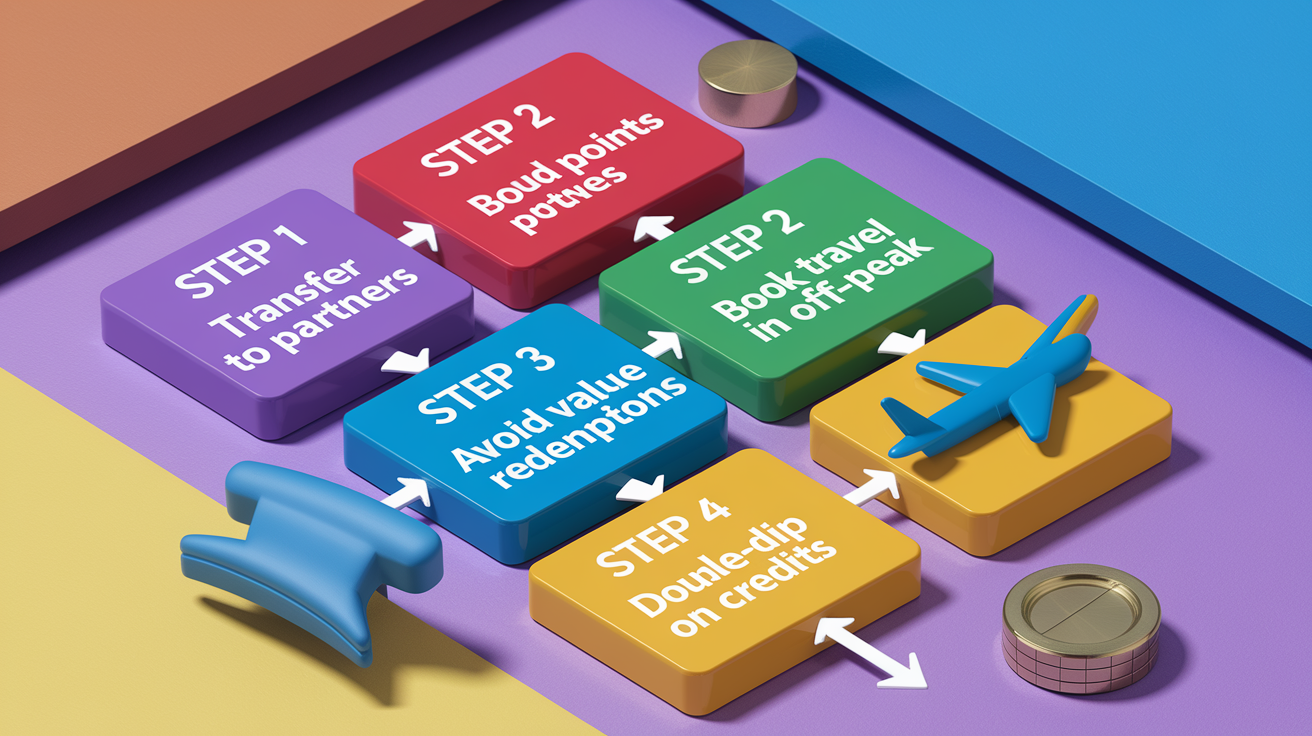
Smart redemption strategies turn points into flights and hotels worth two or three times the cash value of the same points redeemed for gift cards or merchandise.
Step 1: Transfer points to airline or hotel partners for flights and award stays. Chase Ultimate Rewards and Amex Membership Rewards both transfer 1:1 to partners like United, Southwest, Delta, Hyatt, and Marriott. A domestic economy flight that costs $400 cash might cost only 25,000 transferred points, yielding 1.6¢ per point instead of the baseline 1¢ redemption rate for statement credits.
Step 2: Book travel during off-peak seasons or use flexible-date searches to find lower award rates. Airlines and hotels adjust award pricing by demand. A Tuesday flight in February often requires 20 to 30 percent fewer points than a Friday flight in July for the same route.
Step 3: Avoid low-value redemptions like gift cards, shopping portals, and merchandise. These typically deliver 0.5¢ to 1¢ per point, cutting your reward value in half compared to travel transfers.
Step 4: Stack card benefits with loyalty-program earnings. When you book a hotel stay or flight with your travel card, you earn both credit-card points and airline miles or hotel points from the loyalty program. Double-dipping on the same purchase.
Following these four steps can push your average redemption value from 1¢ per point to 1.5¢ to 2¢ per point. A 75,000-point sign-up bonus worth $750 at baseline redemption becomes $1,125 to $1,500 when transferred to partners and redeemed for premium-cabin flights or peak-season hotel stays.
Expert Recommendations for Choosing the Right Travel Card

Choosing the right travel card depends on how often you fly, which airlines you prefer, and how much you spend each month on dining and travel.
Match the card to your travel frequency. If you fly fewer than four times per year, choose a no-fee or $95-fee card like Capital One VentureOne or Chase Sapphire Preferred. If you fly monthly, premium cards like the Amex Platinum or Chase Sapphire Reserve justify their fees through lounge access, travel credits, and elevated earning rates.
Prioritize transferable points over co-branded airline cards unless you’re fiercely loyal to one carrier. Chase Ultimate Rewards and Amex Membership Rewards transfer to 14 or 15 partners, giving you flexibility to book whichever airline offers the best redemption rate. Co-branded cards like the United℠ Explorer or Delta SkyMiles® Gold lock you into one program but deliver perks like free checked bags and priority boarding.
Calculate whether you’ll use every credit before paying a high annual fee. Premium cards like the Amex Platinum offer $600+ in hotel credits, $300 in entertainment, and $200 in Uber Cash, but these credits require active enrollment and specific spending patterns. If you don’t subscribe to streaming services, rarely use rideshare, or don’t shop at the credit-eligible retailers, the card’s net value drops below its $895 fee.
Pick a card that aligns with your actual spending. If dining and travel are your top two spending categories, choose a card that offers 3x to 5x in those areas. If you want simplicity, pick a flat 2x-everywhere card like the Capital One Venture. Your best travel card is the one whose bonus categories and credits match the purchases you already make every month.
Final Words
In the action: we gave 4 top travel credit cards with fees ($0–$695), typical sign‑up bonuses (50,000–100,000 points), and 3x–5x earning categories; a 5‑row comparison of fees and perks; three card profiles with lounge access, travel credits, and protections; pros and cons; and practical steps to squeeze more value from points.
If you still ask what are the best travel reward credit cards, match your travel habits to fees and perks, then pick the card that earns most on your spending. You’ll get more value when you focus on real savings, not hype.
FAQ
Q: What credit card has the best rewards for travel and who offers the best travel rewards credit card?
A: The credit card with the best travel rewards depends on your habits; top issuers are Chase, American Express, and Capital One – cards range $0-$695, offer 50,000-100,000 point bonuses, and 3x-5x on travel or dining.
