
Fee-free ATMs aren’t really free.
Someone is paying for your cash.
Networks like Allpoint, MoneyPass, and CO-OP move the usual $3-$5 surcharge into membership and interchange (per-withdrawal) fees paid by banks and ATM owners.
The waiver only applies when both your bank and the ATM operator belong to the same network; if one side isn’t in contract, the surcharge can still appear.
This post explains who pays what, how routing triggers the fee screen, and simple checks to avoid surprise charges.
Core Mechanics Behind Fee‑Free ATM Network Features

Fee‑free ATM networks work through pre‑negotiated contracts between financial institutions and ATM operators. No consumer surcharges involved. When a bank or credit union joins a network like Allpoint, MoneyPass, or CO‑OP, it pays membership and routing fees to the network operator, and those fees replace the typical $4 to $5 surcharge that would otherwise land on the customer at an out‑of‑network machine. The business model shifts costs behind the scenes. Networks collect membership dues, ATM owners earn interchange income per transaction, and issuing banks save on customer service complaints and retention costs. This arrangement only delivers a surcharge waiver when both the card issuer and the ATM operator have aligned contracts. If the agreements are incomplete or one side is out of contract, the surcharge can still appear even if the machine displays a network logo.
The financial rationale is straightforward. Banks gain a national or global ATM footprint without owning thousands of machines. ATM operators secure steady transaction volume and interchange revenue. Customers get convenience without fees. Networks act as matchmakers, setting technical standards, managing routing, and making sure all parties honor surcharge waivers. Membership fees are typically tiered by institution size or transaction volume, and interchange fees per withdrawal flow from the issuer to the ATM owner through the network. Retailers or third‑party operators who host ATMs may accept lower per‑transaction revenue in exchange for foot traffic or negotiate placement incentives, which further subsidizes the zero‑surcharge promise.
Five parties work together to deliver fee‑free withdrawals:
ATM operator owns or leases the physical machine and earns interchange per transaction instead of surcharges.
Acquirer processes and settles transactions on behalf of the ATM operator.
Issuing bank or credit union authorizes the withdrawal, debits the customer account, and pays network and interchange fees.
Network operator manages routing, enforces surcharge‑waiver contracts, and collects membership and routing fees.
Merchant host provides the retail location (drugstore, gas station, grocery chain) where the ATM sits, often receiving a share of interchange or other incentives.
Bank and Credit Union Partnerships That Enable Fee‑Free ATM Access

Partnership agreements determine exactly who absorbs surcharge costs and under what conditions. When a bank or credit union signs on to a network, it commits to pay membership fees and per‑transaction interchange. In return, the network guarantees that participating ATM operators will waive surcharges for that institution’s cardholders. The institution may also agree to reimburse its customers for any out‑of‑network fees incurred at non‑partner ATMs, further broadening access. CO‑OP serves almost exclusively credit unions and adds shared‑branch services. Allpoint and MoneyPass welcome traditional banks, online‑only fintechs, and credit unions. Retailers hosting ATMs typically work with third‑party operators who join networks on behalf of multiple machine owners, so one CVS ATM might be fee‑free for ten different banks even though CVS isn’t a financial institution.
Revenue and surcharge waivers are spelled out in multi‑party contracts. The ATM operator agrees to waive its usual $3 to $4 surcharge if the transaction comes from a network member’s card. In exchange, the operator receives a guaranteed interchange payment, often $0.50 to $1.50 per withdrawal, plus any network incentives. The issuing bank pays that interchange and its network membership fee but saves the cost of building or leasing thousands of ATMs. Customers see a zero surcharge. The bank retains customers who might otherwise switch to competitors with better ATM access. The network earns fees from all sides. If an issuer falls behind on membership dues or an operator exits a contract, the surcharge waiver evaporates immediately, even if logos and maps haven’t been updated yet.
How banks negotiate and join fee‑free networks:
- Institution contacts the network operator (Allpoint, MoneyPass, CO‑OP, etc.) and submits membership application with institution size, card volume, and geographic footprint.
- Network quotes membership fees (flat annual or tiered by transaction count) and interchange rates. Issuer reviews cost versus estimated customer retention benefit.
- Both parties sign participation agreement specifying surcharge waiver rules, routing requirements, branding rights, and termination clauses.
- Issuer updates card routing tables to recognize network codes and integrates network ATM locator data into mobile app and website maps.
How Fee‑Free ATM Routing and Processing Works

Behind every surcharge‑free withdrawal is a multi‑step routing and authorization dance involving the card, the ATM, the network, and the issuing bank. When you insert or tap your debit card, the ATM reads the magnetic stripe or chip to identify which networks the card can use. Visa Plus, Mastercard Cirrus, Accel, proprietary bank networks, or third‑party networks like Allpoint. The machine compares those network codes against its own routing agreements to determine whether a surcharge waiver applies. If the ATM and your card share a common network that both the ATM operator and your issuer have contracted with, the system flags the transaction as in‑network and skips the surcharge. If not, federal law requires the ATM to display a clear surcharge notification and ask you to accept or cancel before dispensing cash.
Routing rules control which fees appear and when. The ATM’s acquirer sends the authorization request through the matched network to your issuing bank, including details of the requested amount, ATM location, and network code. Your bank performs a real‑time fraud check, verifies your PIN, confirms your balance covers the withdrawal, and either approves or declines the transaction. If approved, the network and acquirer route the approval back to the ATM, which then decides whether to display a surcharge prompt. In‑network contracts instruct the ATM to suppress that prompt entirely. Out‑of‑network transactions trigger the mandatory disclosure. Once you accept (or if no surcharge applies), cash is dispensed, your account is debited, and the settlement process begins.
Step‑by‑step processing and settlement:
Card insertion and network identification. ATM reads card data and identifies all compatible routing networks (chip, mag stripe, or contactless).
Acquirer routing. ATM sends authorization request via its acquirer and the selected network to the card’s issuing bank.
Issuer authorization. Bank checks balance, PIN, fraud flags, and daily limits. Approves or declines in milliseconds.
Surcharge prompt behavior. If in‑network contract exists, ATM skips surcharge screen. If out‑of‑network, ATM displays legally required fee notice and waits for cardholder to accept or cancel.
Cash dispensing. On approval and acceptance (if needed), ATM releases cash and logs the transaction amount.
Settlement and reimbursement. Network settles interchange between acquirer and issuer. If issuer offers fee reimbursement, it posts a credit to the customer’s account on the next statement cycle.
Major Fee‑Free ATM Networks and How Their Features Work

Three dominant networks cover the vast majority of surcharge‑free ATM access in the United States. Allpoint, MoneyPass, and CO‑OP. Allpoint operates the largest global footprint with more than 55,000 ATMs, concentrated heavily in retail chains like CVS, Target, and Walgreens. Its partner list includes major online banks and credit unions such as Ally, Discover, and PenFed. MoneyPass fields approximately 40,000 ATMs and is especially popular with fintechs and online‑only banks that lack physical branches. Its machines appear frequently in convenience stores, gas stations, and regional grocery chains. CO‑OP takes a different approach by serving nearly 30,000 ATMs plus over 5,500 shared credit‑union branches, giving members not only cash access but also teller services and deposit capability at participating credit unions nationwide.
Deposit functionality is one of the sharpest differentiators among networks. CO‑OP’s shared‑branch model means many of its ATMs at credit‑union locations accept cash and check deposits, and some locations even offer over‑the‑counter services like money orders and loan payments. Allpoint has begun rolling out “Allpoint+” deposit‑enabled ATMs at select retail sites, but the majority of Allpoint machines remain withdrawal‑only. MoneyPass deposit capability is similarly limited and inconsistent. Most MoneyPass ATMs are designed for cash dispensing, and users must verify deposit acceptance location by location. If you need to deposit cash or checks regularly, CO‑OP typically provides the most reliable access. Allpoint and MoneyPass are best suited for everyday withdrawals and balance inquiries.
| Network | Approx. ATMs | Typical Hosts | Deposit Capability |
|---|---|---|---|
| Allpoint | >55,000 globally | CVS, Target, Walgreens, Costco | Limited (Allpoint+ rollout) |
| MoneyPass | ~40,000 U.S. | Convenience stores, gas stations, groceries | Varies by location; mostly withdrawal‑only |
| CO‑OP | ~30,000 ATMs + 5,500 branches | Credit union branches, select retail | Widespread at branches; deposit‑friendly |
All three networks offer mobile apps and web‑based locator tools that use GPS to find nearby machines, filter by deposit capability, and display real‑time availability. Signage on ATMs sometimes lags behind contract changes. An ATM may display an Allpoint logo even after the operator’s contract has expired, or a newly added machine may not yet show the network decal. Always verify participation through your bank’s mobile app or the network’s official locator before assuming surcharge‑free access, especially if you’re traveling or visiting an unfamiliar location. Geographic coverage also varies. Allpoint’s retail partnerships deliver the densest metro and suburban access, MoneyPass shines in small towns and highway corridors where convenience stores dominate, and CO‑OP’s credit‑union footprint covers all 50 states but is strongest in regions with high credit‑union membership.
Cardholder Eligibility Rules for Using No‑Fee ATMs

Fee‑free ATM access requires an active account or membership at a financial institution that participates in the network. You can’t simply walk up to an Allpoint ATM and expect zero fees unless your debit or ATM card is issued by a bank or credit union that has a contract with Allpoint. The network logos printed on your card (Visa Plus, Mastercard Cirrus, Accel, or a proprietary network symbol) determine which ATMs your issuer has configured for surcharge‑free routing. Prepaid card programs often participate in fee‑free networks if the card issuer has signed on. For example, many payroll and government‑benefit prepaid cards route through MoneyPass or Allpoint to give cardholders access without monthly fees.
Daily withdrawal limits and fraud protections apply universally regardless of network. Most issuers cap ATM withdrawals at $300 to $500 per day, though limits vary by account type and relationship. PIN verification is mandatory for cash withdrawals, and the issuer’s fraud‑detection systems monitor transaction patterns. Unusual locations, rapid successive withdrawals, or amounts far above your normal behavior can trigger a temporary block even at in‑network ATMs. Eligibility can also differ machine by machine. An ATM displaying both Allpoint and MoneyPass logos may waive surcharges for your card under one network but not the other, depending on which routing path your issuer has prioritized and which network the ATM operator has contracted with most recently.
Typical cardholder requirements for surcharge‑free access:
Hold a checking, savings, or prepaid account issued by a bank, credit union, or fintech that participates in the network.
Possess a debit or ATM card bearing the network’s logo (or rely on issuer routing if logo is not visible).
Use a valid PIN and remain within daily withdrawal and transaction limits set by the issuer.
Verify the specific ATM’s participation status through your issuer’s app or the network locator. Logo presence alone doesn’t guarantee fee‑free access if contracts have lapsed.
Identifying In‑Network ATMs and Avoiding Surcharges

Finding a surcharge‑free ATM starts with your bank’s mobile app, which almost always includes a built‑in locator that uses GPS to map nearby in‑network machines. These app‑based tools are the most reliable because they pull live data directly from your issuer’s contracted networks and update faster than third‑party maps or physical signage. If your bank participates in multiple networks (say, Allpoint and MoneyPass), the app typically shows ATMs from both and may even indicate which machines accept deposits or offer drive‑up access. When you’re planning a trip or a daily commute, open the locator in advance, save a few convenient addresses, and double‑check that those ATMs still display your network’s logo when you arrive.
Network operators also publish their own locator tools on websites and standalone mobile apps. Allpoint, MoneyPass, and CO‑OP each offer searchable maps where you enter a ZIP code or address and see every participating ATM within a chosen radius, often with filters for features like 24‑hour access, deposit capability, or drive‑through lanes. These tools can reveal machines your bank’s app might not highlight if your issuer’s data feed is delayed. Physical signage (stickers and decals on the ATM itself) provides a final confirmation, but remember that logos can remain on machines after contracts end or appear missing on newly added ATMs. If you see conflicting information, trust your bank’s app or the network’s official locator over the sticker.
Quick steps to locate fee‑free ATMs and avoid surprise charges:
Open your bank’s mobile app and tap the ATM locator. Allow GPS access for real‑time nearby results.
Use the network’s own locator (Allpoint Locator, MoneyPass ATM Finder, CO‑OP Locator) to cross‑check and explore additional machines.
Search Google Maps or Apple Maps for “no‑fee ATM” plus your bank’s name (example: “no‑fee ATM Ally Bank”) to find community‑sourced locations.
Look for network logos on the ATM itself (Allpoint, MoneyPass, CO‑OP, or your bank’s brand), but verify participation through an app if the sticker looks old or faded.
Watch for the surcharge notification screen. Federal law requires ATMs to disclose any fee before completing the transaction, so if you see a dollar amount, cancel and find a confirmed in‑network machine.
Differences Between Fee‑Free vs. Traditional Fee‑Charging ATMs
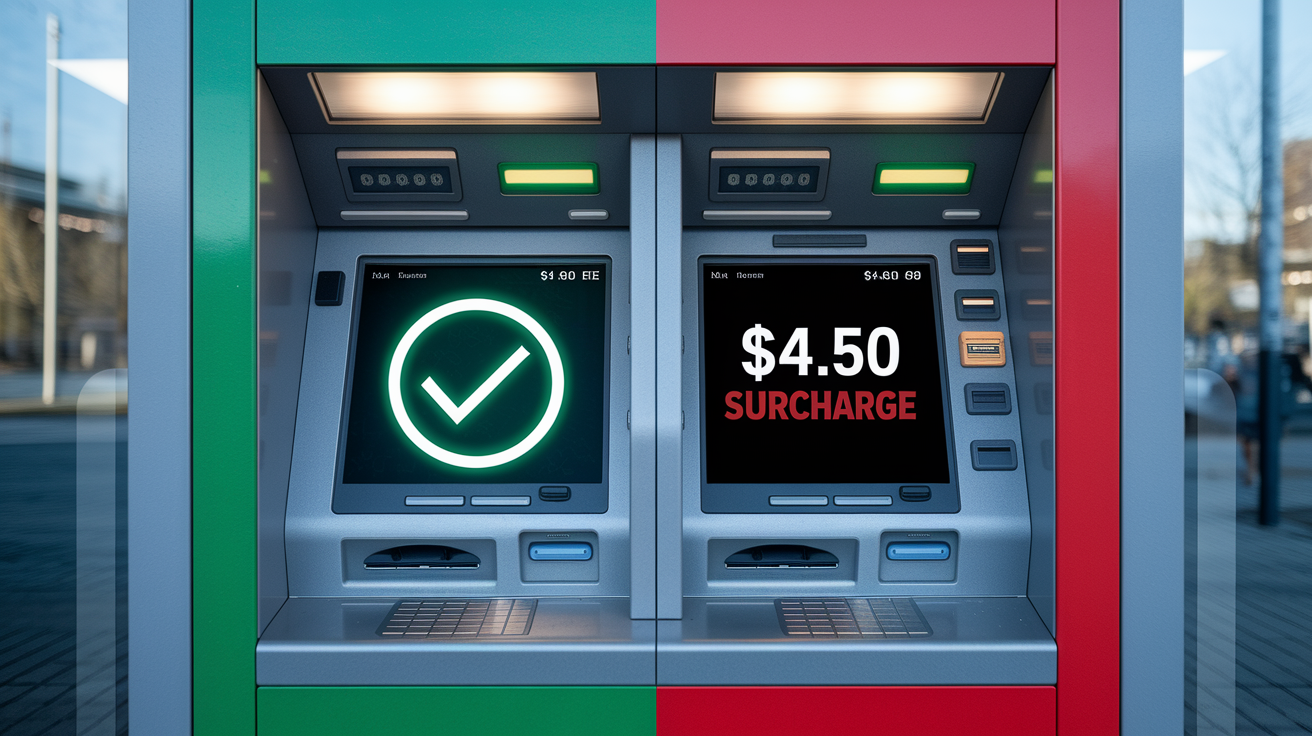
Out‑of‑network ATMs typically hit you with two separate charges: the ATM operator’s surcharge (usually $3 to $4) and your own bank’s foreign‑ATM fee (another $1 to $2 or more), bringing the total cost to around $4 to $5 per withdrawal. Federal law mandates that the ATM display the operator’s surcharge amount on‑screen and require you to accept or cancel before dispensing cash, but that disclosure does nothing to reduce the fee. It just ensures you know the cost before committing. Fee‑free ATMs eliminate the operator surcharge entirely through network agreements, and your issuer waives its own out‑of‑network fee because the transaction stays in‑network. Some banks go further by reimbursing out‑of‑network fees monthly, posting credits to your account at the end of each statement cycle up to a stated cap like $10 or $15.
Surcharge‑waiver policies depend entirely on contracts being active and properly configured. Even inside a network, an ATM can still charge a surcharge if the operator’s agreement with the network has expired or if your issuer’s routing tables haven’t been updated to recognize that machine. Reimbursement limits vary widely. Some premium checking accounts offer unlimited domestic ATM fee refunds, while others cap reimbursements at a fixed dollar amount per month or per transaction. The reimbursement process is automatic. Your bank detects the foreign‑ATM fee in the transaction data, then issues a credit on your next statement. But you may wait several days or even a full billing cycle to see the refund.
In‑network versus out‑of‑network comparison:
Operator surcharge is waived at in‑network ATMs, charged (and disclosed) at out‑of‑network machines, typically $3 to $4.
Issuer foreign‑ATM fee is $0 for in‑network, $1 to $2+ for out‑of‑network unless issuer reimburses.
Disclosure requirement means federal law requires surcharge notification before cash is dispensed at all ATMs. In‑network machines simply show $0.
Reimbursement means some issuers refund out‑of‑network fees monthly up to a cap. In‑network transactions never need reimbursement because fees are prevented at the source.
Hidden Limitations and Caveats of Fee‑Free ATM Networks
Deposit capability is inconsistent across fee‑free networks, and you can’t assume that every ATM in a network accepts cash or check deposits. Allpoint and MoneyPass machines are predominantly withdrawal‑only. Even within CO‑OP’s network, deposit acceptance depends on whether the specific ATM is located at a shared branch or a retail site. If you need to deposit regularly, verify each machine’s capabilities in the network locator before driving across town. Signage also lags real contract status. An ATM may display a network logo weeks or months after the operator’s participation agreement has ended, or a newly enrolled machine may not yet have the decal applied. Relying solely on stickers can lead to unexpected surcharges.
Daily withdrawal limits are set by your issuer, not the network, and those caps apply whether you use an in‑network or out‑of‑network ATM. Common limits range from $300 to $500 per day, though some premium accounts allow higher amounts. Reimbursement caps can also surprise you. An issuer advertising “ATM fee refunds” may limit reimbursements to $10 or $15 per month, so five out‑of‑network withdrawals in a heavy‑travel month could exceed your cap and leave you paying some fees out of pocket. Third‑party ATM operators occasionally impose exceptions. An independently owned machine inside a convenience store might technically be in‑network but still charge a small service fee if the operator’s contract includes carve‑outs or special terms.
Common hidden limitations to watch for:
Deposit functionality is not guaranteed. Most retail‑hosted ATMs are withdrawal‑only. Always verify in the locator before attempting a deposit.
Network signage and logos can be outdated. An ATM showing a network decal may no longer participate if the contract expired recently.
Daily withdrawal limits are enforced by your issuer regardless of network. Exceeding your cap will trigger a decline even at fee‑free machines.
Reimbursement policies often include monthly dollar caps ($10 to $20 common) or per‑transaction limits. Read account terms to avoid surprise out‑of‑pocket fees.
Practical Tips for Using Fee‑Free ATM Network Features Effectively

Start by confirming which networks your bank or credit union participates in. Check your bank’s website, call customer service, or review your account agreement. Once you know your networks, download the official locator apps for Allpoint, MoneyPass, or CO‑OP and your bank’s mobile app, then map ATMs along your daily commute, near your workplace, and in neighborhoods you visit regularly. Save a few addresses in your phone or mark them on a personal map so you always have a backup option when you need cash. If you travel frequently, search for in‑network ATMs at your destination before you leave. Major airports, hotel districts, and tourist areas often have retail chains that host fee‑free machines.
Verify deposit functionality before you need it. Not all ATMs in a network accept deposits, so if you regularly deposit cash or checks, filter network locator results by “deposit‑enabled” and test a few machines near you to confirm they work as expected. If your current account offers limited ATM access, consider switching to a bank that reimburses out‑of‑network fees or partners with a larger network. Reimbursement accounts are especially useful if you live in a rural area with few in‑network ATMs or if you travel internationally. Just confirm the reimbursement cap and whether it covers foreign transaction fees. You can also reduce ATM dependence by requesting cash back when you pay with your debit card at supermarkets, pharmacies, and big‑box stores. Most retailers offer $5 to $50 cash back per transaction, and some allow up to $200, all without any fee.
Always watch for the surcharge notification screen, even at ATMs you believe are in‑network. If a dollar amount appears, cancel the transaction immediately and use your bank’s app to find a confirmed fee‑free machine nearby. Check your account statements monthly to spot any unexpected ATM fees. If you see a charge that should have been waived, contact your bank right away. They can investigate routing errors or expired contracts and may issue a courtesy refund. Finally, keep your network locator apps updated and refresh your saved ATM list every few months, since retail locations close, contracts change, and new machines are added regularly.
Six practical strategies to maximize fee‑free ATM access:
Use your bank’s mobile app and network locator tools to map fee‑free ATMs along your routine routes and travel destinations.
Filter network searches by deposit capability if you need to deposit cash or checks, and test machines in advance.
Switch to a checking account that reimburses out‑of‑network ATM fees if your current network coverage is limited. Compare monthly reimbursement caps before opening.
Request cash back at grocery stores, pharmacies, and retail checkouts to avoid ATM fees entirely. Most stores allow $5 to $50, some up to $200.
Verify participation by checking for the surcharge notification. If a fee appears on‑screen, cancel and find a confirmed in‑network ATM.
Review monthly statements for unexpected ATM charges and report routing errors to your bank immediately for possible refunds.
Final Words
In the action, we showed how fee‑free ATM networks work: pre‑negotiated deals, membership and interchange fees, and which parties get paid. You read about bank partnerships, routing rules, major networks, eligibility, and practical tips.
We flagged the common catch: deposit limits, lagging signage, and reimbursement caps. Always check your bank app and the surcharge prompt before you accept a withdrawal.
If you still ask how do fee free atm network features work, the short answer is banks and operators agree to cover fees so you often skip the $4–$5 hit. Use locators and confirm participation — you’ll keep more cash in your pocket.
FAQ
Q: How to avoid out-of-network ATM fee?
A: To avoid out-of-network ATM fees, use ATMs in your bank’s network, check the bank’s ATM locator, pick accounts that refund fees, use merchant cash-back, and withdraw larger, less frequent amounts.
Q: What does free ATM network mean?
A: A free ATM network means your bank has an agreement with ATM hosts so you aren’t charged the operator’s surcharge; networks and issuers cover costs through membership or interchange fees instead.
Q: Do in-network ATMs charge a fee? Are fee-free ATMs really free?
A: Whether in-network ATMs charge a fee and whether fee-free ATMs are really free: in-network ATMs usually waive the operator surcharge, but your bank might still charge or have reimbursement caps and limits—check terms.
