
Think zero fees means cheaper? Not always.
Schwab’s zero-management tier can hide a 5–6% cash allocation that earns almost nothing and quietly lowers your returns.
It can cost more than a 0.25% advisory fee.
This post breaks down the real costs across Betterment, Wealthfront, Schwab Intelligent Portfolios, Fidelity Go, and Acorns.
You’ll see management fees, fund expense ratios, subscription traps, and how costs change at $5k, $25k, and $100k balances.
Read on to compare robo advisor fees and pick the cheapest choice for your situation.
Robo-Advisor Fees Comparison (At a Glance)

| Provider | Management Fee | Account Minimum | Avg. Fund Expense Ratio | Trading Costs | Additional/Hidden Fees |
|---|---|---|---|---|---|
| Betterment | 0.25% (Digital); 0.40% (Premium) | $0 (Digital); $100,000 (Premium) | 0.07%–0.15% | Included | None; custody included |
| Wealthfront | 0.25% | $500 | 0.06%–0.13% | Included | None; cash account separate |
| Schwab Intelligent Portfolios | 0% (basic); 0.30% (Premium) | $5,000 (basic); $25,000 (Premium) | 0.05%–0.17% | Included | Cash allocation drag (5%–6%); $300 one-time Premium setup |
| Fidelity Go | 0% (up to $25,000); 0.35% (above $25,000) | $0 | 0.04%–0.15% | Included | None |
| Acorns | $3/month (Personal); $6/month (Family) | $5 | 0.05%–0.18% | Included | Flat-rate subscription; higher effective fee on small balances |
The real cost differences aren’t always obvious when you first compare robo-advisors. Betterment and Wealthfront keep it simple with percentage-based fees that grow as your balance does. But Schwab’s basic tier? Zero management fees sounds great until you realize they park 5 to 6 percent of your money in cash earning basically nothing. That drag on returns can cost you more than a 0.25 percent fee would.
Fidelity Go doesn’t charge anything on balances under $25,000. That’s hard to beat if you’re just starting out. And Acorns uses a flat monthly subscription instead of percentages. On a $5,000 account, $3 per month works out to 0.72 percent annually. But on a $50,000 account? That same $3 drops to just 0.072 percent.
What’s cheapest depends entirely on how much you’re putting in.
Understanding Robo-Advisor Fee Structures

Every platform charges differently, and the terminology can be confusing. Here’s what you’re actually paying for.
Management Fee (Advisory Fee): This is the annual percentage the robo-advisor takes to run your portfolio, rebalance it automatically, and handle tax-loss harvesting. If you’ve got a $100,000 portfolio and pay a 0.25 percent management fee, that’s $250 per year.
Fund Expense Ratios (ETF Costs): The mutual funds or ETFs inside your portfolio charge their own annual fees to cover operating costs. Even if your robo-advisor charges zero management fees, you’re still paying the fund’s expense ratio. An ETF with a 0.10 percent expense ratio costs $100 annually on a $100,000 holding.
Trading Costs: The cost of buying and selling securities. Most robo-advisors either roll this into the management fee or offer commission-free ETF trades, so you won’t see a separate charge.
Cash Drag: Some platforms (Schwab Intelligent Portfolios especially) hold part of your account in cash to generate revenue for themselves. That cash typically earns close to zero interest, which quietly eats into your portfolio returns.
Subscription or Flat-Rate Fees: Providers like Acorns charge a fixed monthly dollar amount instead of a percentage. This can be brutal on small balances and incredibly cheap on large ones.
Small fee differences add up fast over time. A 1 percent annual fee on $100,000 costs roughly $28,000 in direct fees over 20 years and forfeits another $12,000 in lost compounding at a 4 percent annual return. The combined cost of management fees and fund expense ratios determines your actual net return.
Example Cost Calculations at Different Investment Levels
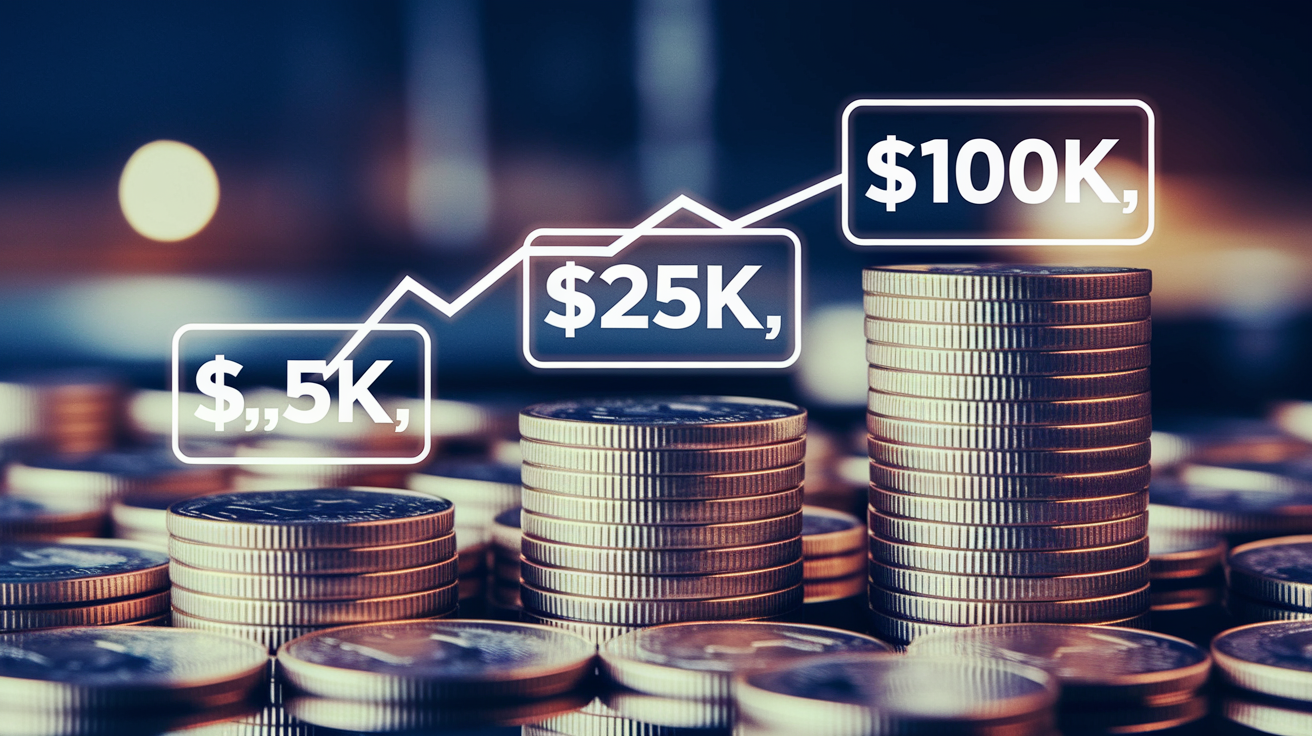
Let’s say you’ve got $5,000 invested with a robo-advisor charging 0.25 percent management plus 0.10 percent average fund expenses. Your total annual fee is 0.35 percent, or about $17.50 per year. A pricier platform charging 0.40 percent management with 0.15 percent fund costs totals 0.55 percent, or $27.50 annually. If you use Acorns at $3 per month, that’s $36 per year. That works out to 0.72 percent, more than double what you’d pay elsewhere.
At $25,000, things shift. A 0.25 percent management fee plus 0.10 percent fund expenses costs $87.50 per year on the low end. A 0.40 percent management fee plus 0.15 percent fund costs runs $137.50 annually. But Acorns still charges $36 per year, which now equals just 0.144 percent of your balance. Suddenly it’s much cheaper than the percentage-based competitors. That’s the crossover point where flat-rate subscriptions start to win.
For a $100,000 portfolio, a low-cost robo-advisor at 0.25 percent management and 0.08 percent fund fees costs $330 per year. A higher-cost platform at 0.50 percent management and 0.12 percent fund fees runs $620 annually. Over 20 years, that $290 annual difference compounds to roughly $11,000 in extra costs, and that’s assuming no account growth. The real difference is much larger once compounding kicks in.
| Investment Amount | Total Annual Cost (Low Range) | Total Annual Cost (High Range) |
|---|---|---|
| $5,000 | $17.50 (0.35%) | $36 (0.72% Acorns subscription) |
| $25,000 | $87.50 (0.35%) | $137.50 (0.55%) |
| $100,000 | $330 (0.33%) | $620 (0.62%) |
Which Robo-Advisors Offer the Best Value?

Best value means the lowest total annual cost when you combine management fees and fund expense ratios, adjusted for what you’re actually getting. A platform charging zero management fees but forcing you to hold 6 percent in cash earning nothing isn’t a bargain if that cash drag costs more than a 0.25 percent advisory fee would.
Fidelity Go: Zero management fees on balances up to $25,000, then 0.35 percent above that. Fund expense ratios average 0.04 to 0.15 percent. No account minimum. Best deal for beginners and small accounts.
Wealthfront: Flat 0.25 percent management fee with fund expense ratios around 0.06 to 0.13 percent. $500 minimum. Tax-loss harvesting included at all balance levels. Solid total cost for accounts over $25,000.
Betterment Digital: 0.25 percent management fee, fund expense ratios of 0.07 to 0.15 percent, no account minimum. Similar total cost to Wealthfront, with slightly higher fund fees but easier access if you’re starting with less than $500.
Acorns (for large balances): Fixed $3 or $6 monthly fee. Once your balance exceeds $50,000, the effective annual percentage drops well below 0.20 percent, making it one of the cheapest options available. But only if you’re already invested at that level.
Long-term investors benefit most from consistently low fees because small annual differences compound over decades. Choosing a robo-advisor with a total annual cost below 0.40 percent can save you tens of thousands of dollars over a 30-year investing horizon compared to a traditional advisor charging 1 to 2 percent. Add up both the management fee and the fund expense ratios, then compare that total to the services you’re actually using.
Provider-by-Provider Fee Highlights

Each robo-advisor structures its fees differently. Here’s a quick side-by-side breakdown.
Betterment: Management fee is 0.25 percent for the Digital plan (no minimum) or 0.40 percent for the Premium plan (requires $100,000 and includes unlimited calls with advisors). Fund expense ratios typically range from 0.07 to 0.15 percent. No trading fees or custody charges. Total annual cost on a $100,000 Digital account runs about $320 to $400 depending on your portfolio mix. No cash drag.
Wealthfront: Charges a flat 0.25 percent management fee with a $500 account minimum. Fund expense ratios average 0.06 to 0.13 percent across its portfolios, which use low-cost Vanguard and other ETFs. No separate trading fees. Tax-loss harvesting is automatic at every balance level. Total annual cost on a $100,000 account is roughly $310 to $380. No hidden cash allocation requirements.
Schwab Intelligent Portfolios: Zero management fee for the basic tier ($5,000 minimum). But Schwab requires 5 to 6 percent of your portfolio to sit in cash earning minimal interest, which creates a return drag equivalent to roughly 0.10 to 0.15 percent annually. Fund expense ratios range from 0.05 to 0.17 percent. The Premium tier charges 0.30 percent management plus a $300 one-time setup fee and requires a $25,000 minimum. Total annual cost on a $100,000 basic account runs about $150 to $270 including cash drag and fund fees.
Fidelity Go: Zero management fee on balances up to $25,000, then 0.35 percent on balances above that. No account minimum. Fund expense ratios average 0.04 to 0.15 percent, among the lowest around because Fidelity uses its own Flex mutual funds. No trading fees or cash drag. Total annual cost on a $100,000 account is roughly $390 to $500. Best option for accounts under $25,000 thanks to the zero-fee tier.
Acorns: Charges a flat $3 per month for the Personal plan or $6 per month for the Family plan (which includes custodial accounts and a debit card). No percentage-based management fee. Account minimum is just $5. Fund expense ratios range from 0.05 to 0.18 percent. On a $5,000 balance, the $3 monthly fee equals 0.72 percent annually. Expensive. On a $100,000 balance, that same $3 monthly fee equals 0.036 percent annually, making it one of the cheapest robo-advisors available for large accounts. No separate trading or custody fees.
Final Words
You saw the quick cost table, clear fee definitions, and three real cost examples that show how fees change with different portfolio sizes. We also flagged which robo-advisors offer the best value and gave short, provider-by-provider fee snapshots.
This should make it easy to spot the big costs: management fees, fund expense ratios, trading or hidden fees, and account minimums.
If you want to compare robo advisor fees quickly, start with the table, match fees to your balance and goals, and you’ll pick the lower-cost fit that keeps more of your returns.
FAQ
Q: What is the best brokerage for robo-advisors?
A: The best brokerage for robo-advisors depends on your priorities. For lowest costs choose Schwab, for wide fund choices pick Fidelity, and for planning tools go with Betterment or Wealthfront.
Q: Is a 1% fee for a financial advisor worth it?
A: A 1% fee for a financial advisor is worth it if you get true financial planning, tax strategies, or investment outperformance that saves more than the fee; otherwise, cheaper options may be better.
Q: Are robo-advisors worth the fees?
A: Robo-advisors are worth the fees when you want low-cost automatic investing with rebalancing and tax-loss harvesting; not worth it if you need personalized advice or expect active stock picking.
Q: Is 2% fee high for a financial advisor?
A: A 2% fee for a financial advisor is high compared with the industry average near 1%; it’s justified only for extensive planning, niche expertise, or demonstrable net returns above that extra cost.
