
Think robo-advisors are cheap? Think again.
Many charge a small percentage of your balance and layer on fund expense ratios, trading costs, and extra fees for human help.
Those tiny percentages add up into real dollars.
This short guide shows exactly what you actually pay: the platform advisory fee, ETF expense ratios, rebalancing costs, and premium tiers.
You’ll get simple math, real examples, and clear rules for when a robo saves you money and when it doesn’t.
Read on to avoid surprises and pick the cheapest real option for your situation.
Understanding How Robo-Advisor Fees Work

Robo-advisor fees are ongoing charges that automated platforms quietly pull from your account for managing your portfolio. Most calculate fees as a percentage of your total assets under management—the AUM model. Instead of sending you a bill, the platform just withdraws a sliver of your balance each month or quarter. This percentage setup means you pay more dollars as your balance climbs and less when it drops.
Typical robo-advisor management fees run 0.25 percent to 0.50 percent per year. Traditional human advisors commonly charge 1 percent to 2 percent of AUM. On a $100,000 account, a 0.25 percent robo fee costs you $250 per year. A 1 percent traditional advisor fee costs $1,000 per year. That $750 annual gap adds up fast.
Robo platforms usually split costs into several buckets:
Management or advisory fee is the percentage the platform charges for running your account, rebalancing, and providing digital tools.
Fund expense ratios are the internal annual cost of owning ETFs or mutual funds inside your portfolio.
Trading costs cover spreads, custody fees, or commissions, though many robos bundle or waive these.
Premium tier upgrades are add-on charges for human advisor access, tax planning, or estate guidance.
The advertised management fee doesn’t include underlying fund expenses. If a robo-advisor says “0.25 percent,” that’s only the platform fee. The ETFs you own inside the account carry their own expense ratios, usually 0.03 percent to 0.20 percent, which reduce your returns invisibly. Many platforms require a minimum deposit (often $500 to $5,000) and may waive fees entirely for small balances below a threshold, like balances under $10,000 on some platforms.
Technical Breakdown of Robo-Advisor Fee Components

Most robo-advisors calculate your advisory fee daily and deduct it monthly or quarterly. They check your account balance each day, multiply it by the annual fee rate, divide by 365, and track that daily fraction. At the end of the billing period, the platform withdraws the sum of all daily accruals. This method ties your fee tightly to your actual balance during the period, not just the start or end snapshot.
Fund expense ratios are fees charged by the ETF or mutual fund companies whose products you hold. These expenses cover the fund manager’s operating costs. The fund company deducts the expense ratio from the fund’s net asset value before publishing the daily share price, so you never see a separate line item. If an ETF charges a 0.10 percent expense ratio, your return drops by 0.10 percent annually, automatically. When you calculate total cost of ownership, add the robo advisor’s management fee plus the weighted average expense ratio of all the funds in your portfolio.
Explicit trading costs are per-trade commissions (now rare on robo platforms) or account service fees. Implicit costs include bid-ask spreads, the difference between what you pay to buy a share and what you receive when you sell. When a robo-advisor rebalances your portfolio, it buys and sells shares, crossing the spread each time. Many platforms bundle custody fees (the cost of holding your securities at a third-party custodian like Pershing) into the AUM advisory fee, so you pay nothing separately. Other firms charge small transfer fees if you move your account out or wire money.
Hybrid service tiers add complexity. A platform might charge 0.25 percent for pure automation and 0.50 percent or more if you want phone or video meetings with a human certified financial planner. The higher fee covers the salary and time of human advisors plus planning tools. Some platforms use a tiered pricing model where fees drop at higher balance thresholds, like 0.50 percent on the first $100,000 and 0.40 percent above that.
Premium Services & Hybrid Fees
Premium tiers typically combine algorithmic portfolio management with on-demand human advisors, tax planning consultations, or estate planning document prep. Platforms charge an extra fee for these layers because they require licensed professionals and custom work. A pure robo might charge 0.25 percent with no minimums, while the same firm’s hybrid tier charges 0.65 percent and requires a $25,000 minimum. Hybrid fees can include unlimited advisor calls, coordinated tax-loss harvesting across multiple accounts, and scheduled financial plan updates. The extra cost buys personalized advice, not just automated allocation.
Some robo-advisors also separate discrete planning services and charge a one-time project fee ($500 to $2,000) or an hourly rate ($150 to $400 per hour) on top of the base AUM fee. Before paying for a premium tier, confirm exactly what services are included and whether you actually need them.
Robo-Advisor Fee Examples Using Real Dollar Amounts

Fee math is straightforward once you break it into layers. Multiply your balance by each applicable percentage, then add the results. If you’ve got $50,000 in a robo-advisor charging 0.40 percent annually and your portfolio’s weighted ETF expense ratio is 0.08 percent, your total cost is 0.48 percent per year or $240. Monthly, that’s $20. This exercise shows that even small sounding percentages translate to real dollars that leave your account every year.
When you stack the platform’s advisory fee and the underlying ETF expense ratios, the combined drag becomes clearer. A 0.10 percent ETF expense ratio might sound trivial, but on a $500,000 balance it removes $500 per year from your returns before you even count the robo-advisor’s management fee. Below is a table illustrating total annual costs at common fee levels across four representative account sizes.
| Account Balance | 0.25% Advisory Fee | 0.50% Advisory Fee | 0.10% ETF Expense Ratio | Total Annual Cost (0.25% + 0.10%) | Total Annual Cost (0.50% + 0.10%) |
|---|---|---|---|---|---|
| $5,000 | $12.50 | $25.00 | $5.00 | $17.50 | $30.00 |
| $35,000 | $87.50 | $175.00 | $35.00 | $122.50 | $210.00 |
| $125,000 | $312.50 | $625.00 | $125.00 | $437.50 | $750.00 |
| $500,000 | $1,250.00 | $2,500.00 | $500.00 | $1,750.00 | $3,000.00 |
Comparing Robo-Advisor Costs Across Providers

To compare robo-advisors, you need three core variables: the platform’s annual advisory percentage, the weighted average expense ratio of the ETFs in your specific portfolio allocation, and the minimum balance required to open an account. Advertised management fees can look identical (both say “0.25 percent”), but if one provider uses cheaper index ETFs with a 0.05 percent expense ratio and another uses actively managed funds with a 0.15 percent ratio, your total cost differs by 0.10 percent per year.
Real-world comparisons reveal surprising differences. In one head to head analysis using a 60/40 stock/bond allocation at four account sizes, Wealthfront appeared cheapest because the comparison treated its advisory fee as zero in certain promotional scenarios. Vanguard Personal Advisor Service requires a $50,000 minimum and, despite Vanguard’s reputation for low cost index funds, the combined platform fee plus fund expenses placed it among the more expensive options in that specific test, sometimes five basis points (0.05 percent) higher than competitors. That difference means $50 extra dollars per year on a $100,000 balance, which may or may not matter depending on the extra services Vanguard provides.
When evaluating cost across platforms, check these four variables in order:
The platform’s stated AUM percentage (advisory fee).
The weighted average expense ratio of the ETFs or mutual funds in your proposed allocation.
The minimum deposit required to start or to access a given service tier.
Any premium fees for human advisor access, tax-loss harvesting, or planning services.
Total annual fee equals advisory fee plus ETF expense ratios plus any premium surcharges. Even a platform with a higher advisory fee can be cheaper overall if it uses ultra low cost index funds. A low advisory fee paired with expensive underlying funds can end up costing more. Ask for a fee illustration that includes all layers before you transfer money.
Hidden or Additional Costs in Robo-Advisor Pricing

Some robo-advisors charge account setup fees, account closure fees, or outbound transfer fees when you move your money to another custodian. Wire transfer fees (often $25 to $30 per wire) and paper statement fees (a few dollars per month) can also appear. Inactive account fees may apply if you stop making deposits or trades for a long period, though automated platforms rarely enforce these because the whole point is hands off management.
Rebalancing is the process of selling winners and buying losers to restore your target allocation. Most robo-advisors include it at no extra charge within the base management fee. Traditional advisors sometimes bill separately for rebalancing or embed the cost into higher AUM fees. Robo platforms advertise free rebalancing as a feature, but the cost is already baked into the management percentage you pay. The real question is whether rebalancing happens frequently enough to add value without triggering unnecessary taxable events.
Premium add-ons represent another cost layer. Tax-loss harvesting (selling losing positions to offset gains) may be included in a mid-tier plan or cost an extra 0.10 to 0.15 percent. Access to a certified financial planner for one on one calls might require upgrading to a hybrid tier at 0.40 or 0.50 percent instead of 0.25 percent. Estate planning document preparation, will reviews, or trust account management can add project fees ranging from a few hundred to several thousand dollars. Read the fee schedule carefully and decide whether you’ll actually use these extras before paying for them.
Long-Term Impact of Robo-Advisor Fees on Portfolio Growth
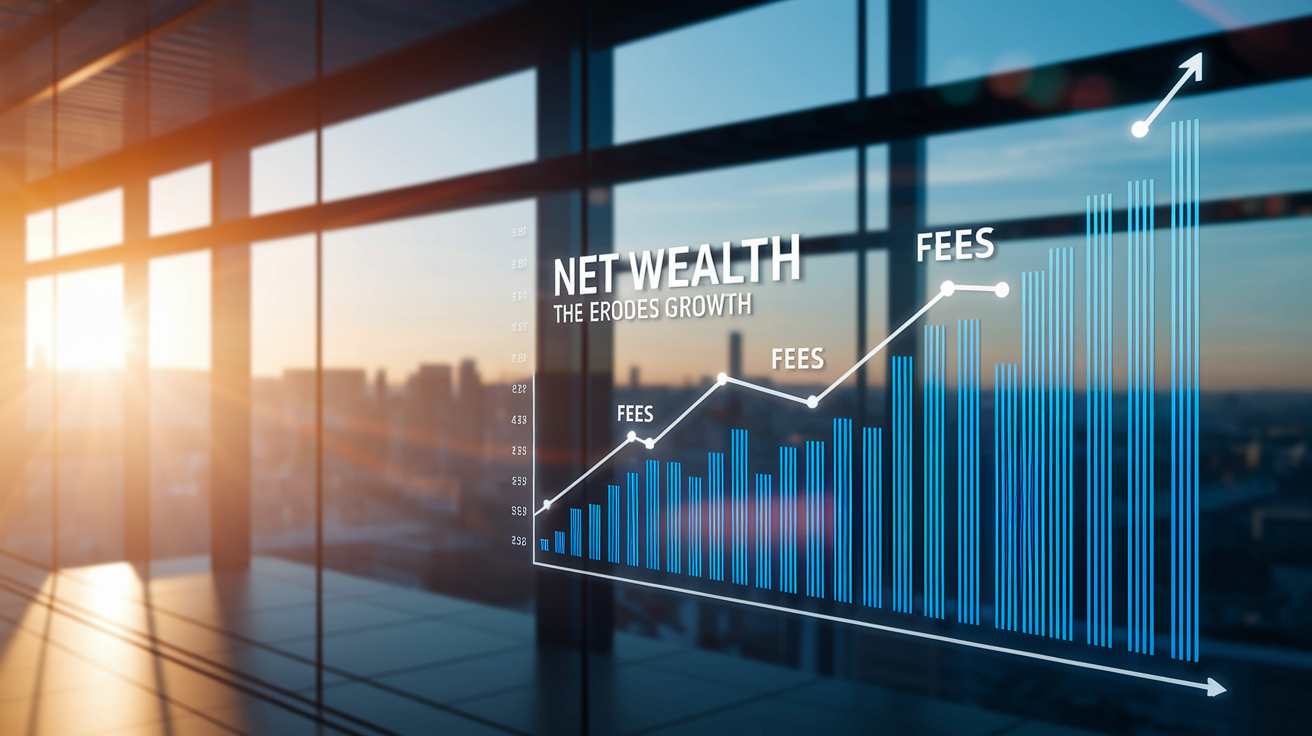
Fees compound in reverse. Every dollar you pay in fees is a dollar that can’t grow, and you also lose all the future growth that dollar would have generated. Over 20 or 30 years, this double hit adds up to large differences in your final balance. Even a small fee difference repeated every year can cost tens of thousands of dollars by retirement.
Consider a $100,000 portfolio growing at 4 percent per year for 20 years. If you pay a 1 percent annual advisory fee, you’ll hand over roughly $28,000 in direct fee payments over two decades, and you’ll lose about $12,000 in compound growth on the money you paid out. Total drag is around $40,000. A 0.25 percent fee on the same account costs roughly $7,000 in direct payments plus $3,000 in lost compounding, for about $10,000 total drag. The gap between a 0.25 percent fee and a 1 percent fee over 20 years at 4 percent growth is approximately $30,000 in your final account value.
Three components explain long term fee impact:
Annual fee paid is the dollars withdrawn each year as a percentage of your current balance.
Lost growth on fees is the investment returns you miss because fee dollars left your account instead of staying invested.
Multi-decade outcome differences is the cumulative effect of both components compounding over 20 or 30 years, which can exceed $100,000 on large balances or high fee scenarios.
Over 30 years with an 8 percent gross return, a $100,000 account grows to about $1,006,000 with no advisory fee. A 0.25 percent fee reduces the ending balance to roughly $939,000 ($67,000 less). A 0.50 percent fee leaves you at about $876,000 ($130,000 less), and a 1 percent fee brings the final balance down to around $761,000 ($245,000 less). Those differences dwarf the convenience of automated rebalancing.
How to Evaluate the Break-Even Point
Higher fees can still make sense if the platform delivers extra value that improves your behavior or outcomes. A robo-advisor charging 0.50 percent with excellent tax-loss harvesting might save you more in taxes each year than the incremental 0.25 percent fee costs. A hybrid service charging 0.65 percent that includes unlimited calls with a certified financial planner might prevent costly mistakes (like panic selling during a market crash) that would cost you far more than the fee.
Calculate whether the additional services translate to measurable benefits: tax savings, better asset location, or improved discipline. If the answer is no, choose the lowest cost provider that meets your core needs. If the answer is yes, compare the incremental fee to the dollar value of the benefit and confirm the benefit is recurring, not one time.
Understanding Fee Transparency and Regulatory Disclosures

Investment advisers managing more than $25 million in client assets must file Form ADV with the Securities and Exchange Commission. Form ADV Part 2 (the disclosure brochure) explains how the adviser calculates fees, whether the firm receives compensation from third parties (such as fund companies or custodians), and any conflicts of interest that could influence recommendations. You can search for and download any registered adviser’s Form ADV at the SEC’s Investment Adviser Public Disclosure website.
Conflict disclosures matter because some robo-advisors are affiliated with fund companies and may steer you toward proprietary ETFs that pay the platform higher fees. Other platforms accept referral payments from banking partners or earn interest on your uninvested cash sweep balances. Form ADV Part 2 will state these arrangements explicitly. If a robo-advisor receives trailing commissions or revenue sharing from funds it recommends, that creates a material conflict. The platform has an incentive to recommend those funds even if cheaper alternatives exist. Check whether the platform is a fiduciary (legally required to act in your best interest) and whether fee disclosures include all revenue sources, not just the management percentage you see advertised.
Documents to Review
Before funding an account, ask for the full fee schedule, account agreement, and a sample quarterly statement. The fee schedule should list the annual management percentage, any tiered pricing, minimum fees in dollars, and charges for specific transactions (wires, paper statements, account closures). Your quarterly account statement will show the exact dollar amount deducted for advisory fees during that period. Transaction confirmations (generated every time the robo-advisor buys or sells a fund on your behalf) show execution prices and can reveal whether you paid a commission or crossed a wide bid-ask spread. Compare the fee deductions on your statement to the percentages promised in the account agreement to confirm accuracy.
Fees of Leading Robo-Advisor Providers: Highlights and Differences

Pure robo-advisors offer algorithm driven portfolio management with no direct human interaction. Hybrid robo-advisors layer certified financial planner access and personalized advice onto the automated platform. Pure robos typically charge lower fees (0.25 to 0.35 percent) because they have minimal labor costs. Hybrid models charge 0.40 to 0.90 percent or higher to cover advisor salaries and custom planning work.
Fee differences among major platforms are often smaller than differences in account minimums and service inclusions. One provider might charge 0.25 percent with a $500 minimum and offer only basic rebalancing. Another charges 0.30 percent with no minimum, includes tax-loss harvesting, and adds access to financial coaches via chat. A third charges 0.50 percent with a $25,000 minimum and provides scheduled video meetings with certified financial planners. Your choice depends on which features you’ll actually use and whether the cost difference justifies the extras.
The mix of ETFs in your portfolio affects total cost even when the advisory fee is identical across providers. One robo-advisor might build a 60/40 stock/bond portfolio using ETFs with an average expense ratio of 0.06 percent. Another uses funds averaging 0.12 percent. That 0.06 percent gap costs $60 per year on a $100,000 balance and compounds over time. Ask for a sample portfolio allocation before you open an account and check the expense ratios of each fund in the mix.
Personal Capital
Personal Capital operates a hybrid model combining digital wealth management with human advisors. The platform lowered its managed account minimum from $100,000 to $25,000 to broaden access. Personal Capital doesn’t publish a single advisory fee percentage. Instead, fees are quoted on a sliding scale based on account size and service level, and the fee typically includes portfolio management, trade execution, and custody costs. The company was purchased in 2020 for $850 million and manages roughly $15 billion in client assets as of 2021.
Personal Capital also offers a free financial dashboard app that tracks around $900 billion in user linked accounts (retirement plans, bank accounts, mortgages) without requiring a managed relationship. The hybrid approach appeals to investors who want both automation and periodic human advice, but expect to pay more than a pure robo-advisor charges.
Wealthfront
Wealthfront charges a flat 0.25 percent annual advisory fee on managed accounts and requires a $500 minimum to start investing (the minimum was $1,000,000 in early versions, then dropped over time to attract smaller investors). Founded in 2008 and relaunched in its current form in 2011, Wealthfront manages over $15 billion in client assets as of 2021. The platform raised a total of $204.5 million in equity funding through six rounds, including a $75 million Series E led by Tiger Global in January 2018.
Wealthfront’s 0.25 percent fee includes automated rebalancing, tax-loss harvesting on taxable accounts, and digital financial planning tools, with no additional charges for those services. The company employs roughly 200 people and positions itself as a low cost, pure robo-advisor alternative to traditional wealth managers.
Betterment
Betterment was founded in 2008 and manages over $40 billion in client assets. The platform has raised more than $200 million in total funding since inception. Betterment offers both taxable brokerage accounts and tax-advantaged IRAs, with features including tax-loss harvesting, automatic rebalancing, scheduled recurring deposits, and mobile apps for iOS and Android. Customer service is available Monday through Friday from 6 a.m. to 5 p.m. Pacific time.
The platform includes a RetireGuide calculator to model retirement savings goals and tax coordinated portfolios that place assets in taxable or tax-deferred accounts to minimize taxes. Betterment’s pricing tiers separate a lower cost digital only plan from a higher cost premium plan that adds access to certified financial planners. Specific fee percentages are structured by tier and balance, so investors must check current pricing when comparing.
How to Compare Robo-Advisor Fees to DIY and Target-Date Fund Alternatives

Do it yourself investing eliminates the robo-advisor management fee entirely. You open a brokerage account, buy a few low cost index ETFs or mutual funds, and rebalance manually once or twice a year. If you choose funds with expense ratios around 0.03 to 0.10 percent, your total cost might be 0.05 percent per year, far cheaper than any robo-advisor. The trade off is time and discipline. You must research allocations, execute trades, track tax lots, harvest losses manually, and avoid emotional decisions during market swings. DIY works well for investors who enjoy financial tasks and have the knowledge to build a diversified portfolio.
Target date funds offer a middle ground. These are single mutual funds that automatically shift from stocks to bonds as you approach a target retirement year. Expense ratios on low cost target date funds from Vanguard, Fidelity, or Schwab range from 0.08 to 0.15 percent per year, with no separate advisory fee. You get automatic rebalancing and a glide path (gradual shift toward conservative assets) built into one fund. Target date funds cost less than robo-advisors but offer no tax-loss harvesting, no custom allocation tweaks, and no human advice. They work best inside retirement accounts like 401(k)s or IRAs where tax optimization is less critical.
Key comparison points between robo-advisors, DIY, and target date funds:
Total annual cost: DIY (0.03 to 0.10 percent) < target date funds (0.08 to 0.15 percent) < robo-advisors (0.35 to 0.60 percent including fund expenses).
Effort required: Robo-advisors (minimal) < target date funds (one purchase, hold forever) < DIY (research, trades, monitoring).
Tax optimization: Robo-advisors (often included) > DIY (if you do it manually) > target date funds (none).
Human advice: Hybrid robo-advisors (available) > pure robo-advisors (limited or none) = DIY = target date funds (none).
If you value hands off convenience, have a taxable account, and want tax-loss harvesting, a robo-advisor charging 0.25 to 0.35 percent may justify the cost. If you’re investing only in an IRA and want the simplest solution, a target date fund is hard to beat. If you have time and interest, DIY delivers the lowest cost.
Choosing a Low-Cost Robo-Advisor Based on Your Situation

Start by listing your non-negotiables: the account types you need (taxable, traditional IRA, Roth IRA), the minimum balance you can meet, whether you want tax-loss harvesting, and whether you need access to human advisors. Rank these by importance, then filter robo-advisors that meet your top two or three requirements. Next, compare total cost by adding the platform’s advisory percentage to the weighted expense ratio of its ETF portfolio.
Many robo-advisors waive fees on small balances or during promotional periods. Some charge zero management fees on the first $10,000 or $25,000 to attract new clients, then apply the standard percentage above that threshold. Discount tiers kick in at higher balances: 0.50 percent on balances up to $100,000, 0.40 percent from $100,000 to $500,000, and 0.30 percent above $500,000. If you expect your balance to grow, model what your fee will be in five years, not just today.
Before committing, ask these five questions:
What’s the all-in annual percentage after adding advisory fees and ETF expense ratios?
Are there account minimums, and do fee waivers apply below certain balances?
Is tax-loss harvesting included at my service tier, and does it apply to my account type?
What premium services cost extra, and will I actually use them?
Does the platform earn revenue from affiliated funds, cash sweeps, or referral arrangements disclosed in Form ADV?
You can lower costs by choosing the base service tier and skipping premium add-ons you don’t need. If the platform offers a tier with human advisor access for 0.50 percent but you never plan to call an advisor, stick with the 0.25 percent digital only tier. Avoid paying for financial planning if you already have a separate fee only planner or if your financial situation is simple enough to manage with free online calculators. Check whether tax-loss harvesting is worth the incremental fee. It adds value in taxable accounts but does nothing in IRAs, so paying extra for it in a retirement account wastes money.
Final Words
You now have the key facts: robo-advisor fees are usually a percent of assets, fund expense ratios sit on top, and typical ranges cluster around 0.25%–0.50%. The post walked through fee mechanics, real-dollar examples, provider comparisons, hidden costs, and how fees compound over time.
Think about your balance, need for human help, and minimums when choosing. This roundup — robo advisor fees explained — gives the numbers to compare instead of guesswork.
Pick the right low‑cost fit and you’ll keep more of what your portfolio earns.
FAQ
Q: What is the average robo-advisor fee and do robo-advisors charge higher fees?
A: The average robo-advisor fee is about 0.25%–0.50% of assets under management; many charge around 0.50%. They’re usually lower than human advisors, who charge about 1%–2%.
Q: Is a 1% fee for a financial advisor worth it?
A: A 1% fee for a financial advisor can be worth it if you need personalized planning, tax optimization, or complex advice; otherwise cheaper robo options often save significant money over time.
Q: Is a 0.25% advisory fee a lot?
A: A 0.25% advisory fee is low: on $100,000 it’s $250 a year. It’s generally a good value unless you need human advice, planning, or services that a higher fee would buy.
