
Think banks sharing your account data is a privacy risk?
It can be, but open banking APIs let banks share specific financial data only when you say yes.
An open banking API is a standard software link that sends balances, transactions, and payment details to a trusted app after you give consent.
It works with consent screens, OAuth (a system that gives apps temporary access without your password), and time-limited tokens for safety.
This post shows how the process works step by step, the real benefits, and when to be cautious.
Core Explanation of Open Banking APIs

Open banking APIs are standardized software interfaces that let banks and financial institutions securely share customer account information with authorized third parties. They only work when a customer explicitly consents, giving apps and services the ability to access specific financial data like account balances, transaction histories, and payment details. The technology removes the need for customers to manually export data or share login credentials, making financial services faster, safer, and more integrated across platforms.
An API (Application Programming Interface) in the banking context acts like a secure messenger between a bank’s internal systems and external applications. When a budgeting app needs to show your spending from multiple bank accounts in one dashboard, it uses open banking APIs to request that data directly from each bank. The bank receives the request, verifies the customer’s consent, and sends back the information in a structured digital format. This exchange happens in seconds, enabling real-time financial insights without anyone at the bank manually processing paperwork or email requests.
For instance, a budgeting app like Mint uses open banking APIs to pull transaction data from your checking and savings accounts. You log in once to grant permission, and the app automatically categorizes your spending, tracks bills, and alerts you to unusual charges. The API delivers a continuous feed of transactions, so you see the latest balance and spending patterns every time you open the app.
Common data shared through open banking APIs includes:
- Account holder name and account type (checking, savings, credit)
- Current balances and available funds
- Transaction histories with dates, amounts, and merchant names
- Account open date, currency, and routing details
- Direct debit and standing order information
Functional Breakdown: How Open Banking APIs Operate

The technical workflow behind open banking APIs follows a clear, repeatable sequence designed to protect customer data while enabling seamless access for authorized apps. Each interaction starts with explicit customer permission and ends with the delivery of data or confirmation of an action, such as initiating a payment.
Here’s the six-step process that powers most open banking API transactions:
- Customer Consent: The user opens a third-party app and selects which bank accounts to connect. The app explains what data it will access and why.
- Authentication: The customer is redirected to their bank’s login page, where they authenticate using their usual credentials (password, biometric scan, or security code).
- Token Issuance: Once the bank verifies the customer’s identity, it issues a temporary access token to the third-party app. This token acts as a secure pass that permits specific, limited actions (reading balances or initiating a payment, for example) without exposing the customer’s login credentials.
- Data Request: The third-party app sends an API call to the bank’s server, including the access token and specifying exactly what information it needs (such as the last 90 days of transactions).
- Bank Response: The bank’s API processes the request, checks that the token is valid and the requested data falls within the granted permissions, then returns the information in a standardized digital format.
- App Usage: The third-party app receives the data and uses it to deliver its service, displaying aggregated account balances, calculating spending trends, or executing a payment instruction.
Standardized API formats, most commonly JSON (JavaScript Object Notation), ensure that data arrives in a predictable, machine-readable structure. This consistency means a budgeting app built to read one bank’s API can connect to dozens of other banks with minimal changes, because all return transaction lists, account identifiers, and balances in the same layout. Standardization reduces development costs and speeds up integration. It also makes it easier for regulators and auditors to verify that data handling meets security and privacy requirements. Without agreed-upon formats, every bank-app connection would require custom engineering, slowing innovation and limiting competition.
Practical Use Cases and Real-World Applications

Open banking APIs power a budgeting app that consolidates accounts from three different banks into a single dashboard. The app pulls transaction feeds every few hours, categorizes each purchase (groceries, rent, subscriptions), and shows spending trends over time. Users can set savings goals and receive alerts when they approach budget limits. The automation removes the manual work of logging into multiple bank sites and copying numbers into a spreadsheet.
Payment platforms use open banking APIs to initiate direct bank-to-bank transfers for e-commerce checkouts. Instead of entering card details, a customer authorizes a one-time payment through their bank account. The platform sends a payment instruction via the API, the customer confirms via their bank’s app, and funds move directly from the customer’s account to the merchant. This method bypasses card networks, reducing fees and settlement times from days to seconds.
Lending platforms tap open banking APIs to assess creditworthiness for applicants with thin credit files. By analyzing months of transaction data (income deposits, recurring bills, savings patterns), lenders build alternative credit scores that reflect actual cash flow rather than traditional credit history. This approach opens access to loans and better rates for freelancers, gig workers, and recent immigrants who may not have established credit bureau records.
Automated savings apps connect to checking accounts via open banking APIs and apply rules-based transfers. Every time a transaction rounds up to the nearest dollar, the app moves the spare change into a linked savings or investment account. The API monitors transactions in real time, calculates the round-up amount, and triggers the micro-transfer without any manual input from the user.
Additional emerging applications enabled by open banking APIs:
- Fraud detection services that flag unusual spending patterns by comparing real-time transaction feeds against behavioral baselines
- Subscription management tools that identify recurring charges, notify users of upcoming renewals, and offer one-click cancellation via payment initiation APIs
- Tax preparation software that imports a full year of business expenses and income directly from business bank accounts, pre-filling forms and receipt logs
- Embedded finance in e-commerce platforms, where sellers receive instant payouts and buyers complete purchases through direct bank authorization instead of card details
Benefits for Consumers, Banks, and Fintechs

Consumers gain greater transparency and control over their financial data. Open banking APIs let users decide which apps access their accounts and revoke that access instantly. Consolidated views across multiple banks reveal the full financial picture in one place, making it easier to spot subscription charges, compare account fees, and track progress toward savings goals. Direct bank payments offer an alternative to cards, often with lower fees and faster settlement. Personalized recommendations powered by transaction-level data help users optimize spending, refinance loans at better rates, or discover high-yield savings accounts matched to their deposit patterns.
Banks benefit by shifting from closed, siloed providers to orchestrators of a broader financial ecosystem. Open banking APIs let banks offer Banking-as-a-Service, licensing their infrastructure to fintechs and generating new revenue streams from API usage fees and partnership deals. API-driven products differentiate banks in a competitive market. A bank that integrates with popular budgeting apps and payment platforms attracts tech-savvy customers who value convenience. Real-time data sharing also improves internal risk management, as banks can monitor customer cash flow and intervene early when accounts show signs of financial stress, reducing default rates and increasing customer retention.
Fintechs and third-party developers unlock innovation by accessing rich financial data that was previously locked inside bank vaults. Faster underwriting and account verification cut the time to approve loans or open accounts from days to minutes. Real-time transaction feeds support dynamic risk monitoring, allowing lenders to adjust credit lines based on current income rather than static snapshots. Embedded finance capabilities let non-financial businesses (retailers, gig platforms, software providers) offer checking accounts, loans, or payment services directly within their apps, creating new revenue opportunities and deeper customer engagement. Aggregated, anonymized transaction data fuels market insights and product development, helping fintechs tailor offerings to specific demographics or spending behaviors.
Security Foundations of Open Banking APIs

OAuth 2.0 serves as the authorization framework that separates user credentials from third-party access. When a customer connects an app to their bank, OAuth redirects them to the bank’s own login page, where they authenticate directly with the institution. The bank then issues a time-limited access token to the app, which carries specific permissions (read account balances, initiate payments) but never the customer’s password. If the token is stolen, the attacker gains only the narrow access granted by that token, and the bank or customer can revoke it instantly. This delegation model means third-party apps never see or store login credentials, dramatically reducing the risk of credential theft.
Strong Customer Authentication (SCA) and multi-factor authentication (MFA) add layers of identity verification before any API transaction proceeds. SCA requires at least two of three elements: something you know (password or PIN), something you have (phone or hardware token), and something you are (fingerprint or facial scan). Most open banking flows trigger SCA at the point of consent or payment initiation, ensuring that even if an attacker steals an access token, they can’t complete high-risk actions without passing the second authentication factor. MFA typically involves sending a one-time code to the customer’s registered mobile device or using biometric checks built into banking apps.
Encryption and tokenization protect data both in transit and at rest. Open banking APIs mandate TLS (Transport Layer Security) for all communications between apps and banks, encrypting data packets so that anyone intercepting network traffic sees only scrambled gibberish. AES (Advanced Encryption Standard) with strong key lengths encrypts sensitive data stored on servers, ensuring that even a database breach doesn’t expose readable account numbers or transaction details. Tokenization replaces actual account identifiers with random reference codes in logs and external systems, so third parties process payments or transactions using tokens rather than real account numbers, limiting exposure if a breach occurs.
Common security risks mitigated by open banking standards:
- Credential theft: OAuth eliminates password sharing, so apps never store or transmit login credentials
- Unauthorized access: Time-limited tokens and permission scopes prevent apps from reading or acting beyond granted consent
- Man-in-the-middle attacks: Mandatory TLS encryption ensures data can’t be intercepted or altered in transit
- Data breaches: Tokenization and encryption at rest protect sensitive information even if an attacker gains access to storage systems
Regulatory Framework: PSD2 and Global Standards
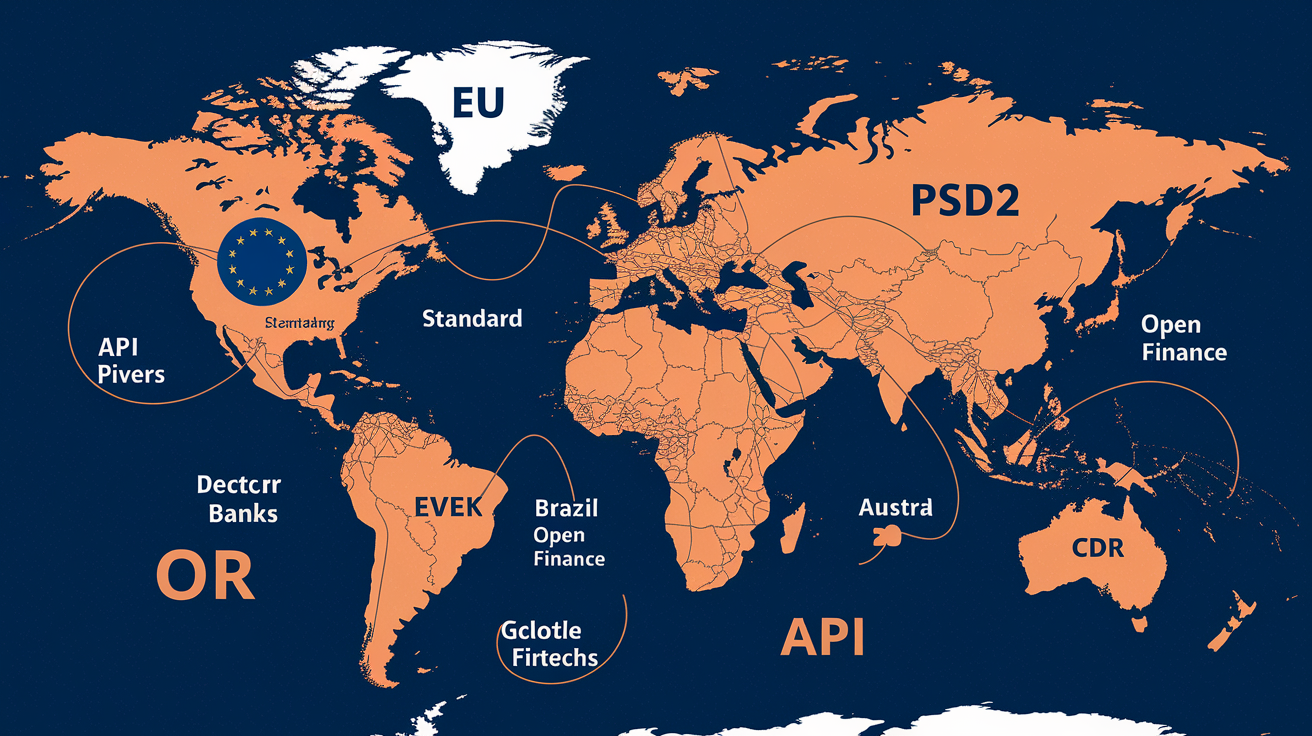
PSD2 (the revised Payment Services Directive) is the European Union regulation that launched the modern open banking era in 2015, with full enforcement beginning in 2018. PSD2 requires banks to provide secure, standardized APIs that let authorized third-party providers access customer account data and initiate payments, as long as the customer consents. The directive defines two key roles: Account Information Service Providers (AISPs), which read account data, and Payment Initiation Service Providers (PISPs), which trigger payments on behalf of customers. PSD2 also mandates Strong Customer Authentication for online payments and account access, forcing banks to implement multi-factor checks that reduce fraud. By opening bank infrastructure to competition, PSD2 aims to increase innovation, lower costs, and give consumers more control over their financial information.
Other regions have adopted similar frameworks, each with local variations. The United Kingdom’s Open Banking Standard, implemented in 2018, goes beyond PSD2 by specifying exact API technical standards and data formats, ensuring consistency across all UK banks. Australia’s Consumer Data Right (CDR), which launched for banking in 2020, grants consumers a legal right to access and share their financial data with accredited third parties, extending the model to energy and telecommunications sectors. Brazil rolled out Open Finance starting in 2021, covering not only bank accounts and payments but also insurance, investments, and foreign exchange, making it one of the most comprehensive data-sharing regimes globally. The United States follows a market-driven approach, with voluntary API adoption by banks and regulatory guidance from the Consumer Financial Protection Bureau emphasizing consumer consent and data security, rather than a single mandated standard.
Data-consent rules form the backbone of all these frameworks. Regulations require that customers explicitly authorize each data-sharing relationship, understand what information will be accessed and for what purpose, and retain the right to revoke consent at any time. Consent must be granular. Customers can approve access to transaction history but deny access to savings account details, for example. Consent screens must be clear, free of legal jargon, and presented before any data flows. Third parties must refresh consent periodically (typically every 90 days under PSD2) to ensure customers remain aware of ongoing access. Privacy laws such as GDPR in Europe layer additional requirements: third parties must minimize data collection, delete data when no longer needed, and provide transparent notices about data processing and storage locations.
| Region | Regulatory Framework | Key Requirement |
|---|---|---|
| European Union | PSD2 (Payment Services Directive 2) | Mandatory API access for AISPs and PISPs with SCA |
| United Kingdom | Open Banking Standard | Standardized API specifications across all banks |
| Australia | Consumer Data Right (CDR) | Legal right to data portability for consumers with accredited providers |
Comparison: Open Banking APIs vs Traditional Banking Systems

Traditional banking systems were built as closed, proprietary platforms where customer data stayed inside the bank’s own servers and third-party access required manual processes or bespoke integrations. If a customer wanted to share account information with a financial advisor or lender, they printed statements, exported CSV files, or granted the third party their online banking login credentials. An insecure practice known as screen scraping, where automated scripts logged into accounts and copied displayed data. Batch processing dominated: transactions cleared overnight, account balances updated once per day, and cross-bank transfers took multiple business days. Each bank used unique data formats and internal systems, so any outside developer trying to build a multi-bank service faced years of custom integration work and ongoing maintenance as banks changed their systems without notice.
Open banking flips this model by mandating real-time, standardized APIs with secure, consent-based access. Customers authorize third parties through OAuth flows that never expose login credentials. Data arrives in consistent JSON structures, enabling developers to build one integration that works across dozens or hundreds of banks. Transactions and balance updates flow in real time or near-real time, supporting instant payments, live spending alerts, and up-to-the-minute financial dashboards. Regulatory frameworks enforce interoperability, so banks can’t lock customers into proprietary ecosystems or block competitors from accessing account data. This shift reduces costs for fintechs, accelerates product development, and gives consumers the freedom to switch providers or use multiple services simultaneously without losing access to their financial history.
Limitations of legacy banking systems that open banking APIs address:
- Manual data export and reconciliation, which is slow, error-prone, and requires repetitive user input
- Credential sharing for third-party access, which creates security vulnerabilities and violates most banks’ terms of service
- Delayed transaction visibility and batch processing, which prevent real-time decision-making and increase fraud exposure
- Vendor lock-in and lack of portability, as customers can’t easily move their financial data to competing services without starting from scratch
Optional Visual Breakdown: How Data Flows Through an Open Banking API

The architecture of an open banking API transaction involves four core components working in sequence to deliver secure, real-time data. First, the user initiates consent through a third-party application, such as a budgeting tool or payment app. The app redirects the user to the bank’s authorization server, a dedicated system that handles identity verification and permission grants. The user authenticates using their banking credentials and approves the specific data-sharing request, perhaps read-only access to transaction history for the past six months. Once consent is confirmed, the authorization server generates a temporary access token encoded with the approved permissions and returns it to the third-party app.
The third-party app then makes an API call to the bank’s resource server, which stores and manages customer account data. The call includes the access token and specifies the exact endpoint and parameters, for example, “GET /accounts/{accountId}/transactions?fromDate=2024-06-01”. The resource server validates the token, checks that it hasn’t expired and that the requested data falls within the granted scope, then retrieves the information from the bank’s core systems. The data is formatted into a standardized JSON structure and transmitted back to the third-party app over an encrypted TLS connection.
Finally, the third-party app processes the data to deliver its service. The budgeting tool might parse transaction descriptions to categorize spending by merchant type, calculate monthly averages, and display visual charts on the user’s dashboard. The payment app might confirm that sufficient funds exist before initiating a transfer. Throughout this flow, no sensitive credentials pass between systems, tokens carry narrow permissions that limit risk, and encryption protects data at every stage. This layered architecture balances speed and convenience with security and regulatory compliance, enabling innovation while safeguarding customer trust.
Final Words
We jumped straight into what open banking APIs do, how they work, real use cases, benefits, security basics, and the regulatory landscape. Short, practical, and example-led.
You saw how budgeting apps, instant payments, lending checks, and account aggregation use shared data with your consent. The big idea: more useful apps and smoother money moves.
If you’re asking what is open banking api and how does it work — it’s a set of bank APIs that let trusted apps access your account data after you say yes. More choice, less hassle.
FAQ
Q: What is an open banking API?
A: The open banking API is a way for banks to let third‑party apps access customers’ account data and initiate payments with consent, enabling budgeting tools, account aggregation, and fintech integrations.
Q: How do open banking APIs work?
A: Open banking APIs work by getting customer consent, authenticating the app, issuing a token, requesting data, the bank responding, and the app using JSON‑formatted responses to display or act on data.
Q: What types of bank data can open banking APIs share?
A: Open banking APIs can share account balances, transaction histories, account holder details, direct debits and standing orders, and basic product information like account types and limits when you give consent.
Q: What are common use cases for open banking APIs?
A: Common use cases include budgeting apps pulling transactions, account aggregation across banks, instant payment initiation, credit risk checks for lending decisions, and automated savings or investment tools.
Q: How do consumers benefit from open banking APIs?
A: Consumers benefit from open banking APIs with clearer financial views, faster payments, personalized offers, quicker loan decisions, and tools that automate budgeting and boost savings habits.
Q: Are open banking APIs secure?
A: Open banking APIs are designed to be secure: they use OAuth2 for authorization, strong customer authentication, encryption and tokenization, and frequent auditing to limit access to consented apps.
Q: Who can access my bank data through open banking APIs?
A: Only third‑party providers you explicitly authorize and banks that verify them can access your data via open banking APIs, and you can revoke that consent anytime through the app or your bank.
Q: How are open banking APIs regulated around the world?
A: Open banking APIs are regulated by frameworks like PSD2 in the EU, UK Open Banking, Australia’s CDR, and Brazil’s Open Finance, each setting rules for data access, consent, and oversight of providers.
Q: How do open banking APIs differ from traditional banking systems?
A: Open banking APIs differ by offering real‑time, standardized data and interoperable connections, while legacy banking systems rely on closed networks, batch processing, and limited third‑party access.
Q: Can businesses use open banking APIs to make or receive payments?
A: Yes, businesses can use open banking APIs to initiate payments directly from customer accounts, reducing friction and often offering faster, cheaper payment options than traditional card routes.
Q: What should developers expect about API formats and integration?
A: Developers should expect standardized formats like JSON, scoped access tokens, clear endpoints for balances and transactions, and easier multi‑bank integration when standards are followed.
