
What if you’re paying thousands in broker fees and don’t even know who gets what?
Broker fees and commissions shape the money you keep from every deal.
This post shows the difference: flat broker fees (service or platform charges) versus percentage commissions (a slice of the deal).
You’ll see when each is charged, typical rates across real estate, trading, and insurance, and how timing affects your cash flow.
By the end you’ll know which model costs you more and when to negotiate or walk away.
Core Breakdown of How Broker Fees and Commissions Work in Practice

Broker fees and broker commissions are what you pay to the people who arrange or execute financial transactions. Here’s the split: broker fees are usually flat or service-based charges (think account maintenance, platform access, specific tasks), while broker commissions get calculated as a percentage of the transaction or tied to performance. The commission structure explained differs wildly by industry. Real estate agents take a cut of the sale price, stock brokers charge per contract or let you trade equities for free, and insurance agents pull a slice of your premium. Understanding the fee vs commission difference matters because a flat broker fee gives you predictable costs. A percentage commission? That scales with the size of your deal.
Timing decides when you actually pay. Real estate broker commissions hit at closing when money changes hands. Trading commissions leave your account the second you buy or sell. Insurance broker commissions get paid by the carrier when a policy goes live or renews, and advisory fees get billed monthly or quarterly based on your account balance. Knowing the trigger helps you plan cash flow and dodge surprises at settlement or on your statement.
Why it matters: the way a broker structures pricing controls how much of your money you keep. A 1 percent advisory fee on a $500,000 portfolio costs $5,000 every year. A 6 percent real estate commission on a $300,000 home sale pulls $18,000 off your net before you see anything. Small percentage gaps add up over time and across big transactions.
Common broker fee and commission models:
- Percentage commission – A slice of transaction value (real estate 5 to 6 percent, insurance 2 to 20 percent of premium).
- Flat fee – Fixed dollar amount no matter the size (flat-fee MLS listing $99 to $500, full-service real estate $500 to $2,000).
- Tiered fee – Rate drops as balance or volume climbs (advisory 1 percent on first $1 million, 0.75 percent above that).
- Performance fee – Charged on gains past a benchmark (hedge funds “2 and 20”: 2 percent base plus 20 percent of profit).
- Hourly or retainer – Payment for time (financial planners $150 to $400 per hour, legal or consulting retainers).
- Hybrid structure – Base fee plus per-action charges (low annual fee plus $0.65 per options contract).
Percentage-Based Broker Commission Structures and When They Apply

Percentage rates take over when transaction values swing and the broker’s work scales with deal size. Real estate uses percentage pricing because a $200,000 home and a $2 million estate need different marketing reach, negotiation complexity, and closing work. Insurance broker commissions follow the same idea: higher premiums mean more underwriting support and client service, so carriers pay brokers 2 to 20 percent of first-year premium depending on the product. Life insurance and annuities sit at the high end because policies are complicated and commissions get loaded upfront.
Market norms and competitive pressure shape the rates you’ll see. In U.S. residential real estate, the typical real estate commission has sat around 5 to 6 percent of sale price for decades, even though no law says it has to. Options trading moved to a per-contract model (typically $0.25 to $0.75 per contract) because share prices and lot sizes differ too much for a percentage to make sense. When brokers compete on cost, percentages shrink or flip to flat fees. When they compete on service, percentages stay high and bundled perks justify the rate.
| Industry | Typical Percentage | Example Rate Basis |
|---|---|---|
| Real Estate (residential sale) | 5–6% of sale price | $300,000 sale × 6% = $18,000 total commission |
| Insurance (property/casualty) | 2–20% of annual premium | $1,200 premium × 15% = $180 to broker |
| Options Trading | $0.25–$0.75 per contract | 2 contracts × $0.65 = $1.30 total fee |
Flat Fees, Tiered Pricing, and Alternatives to Commission-Based Broker Models
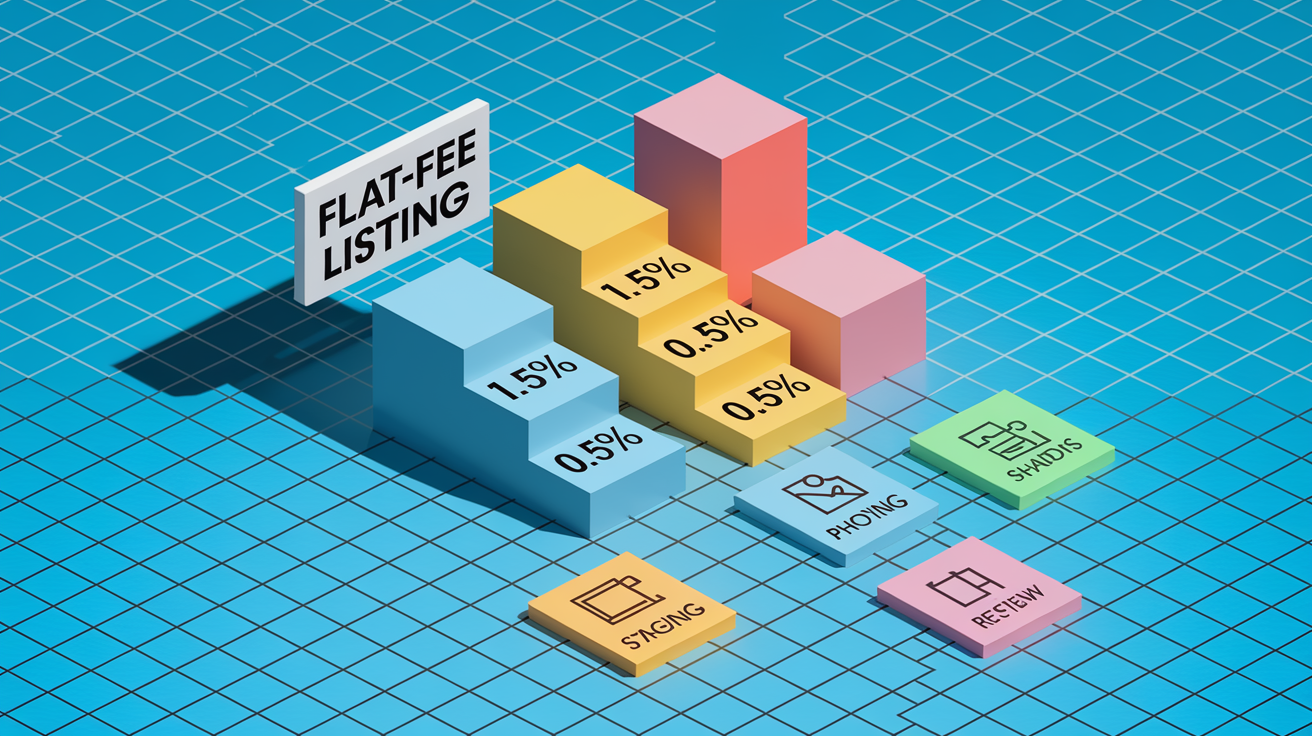
Flat fees break the link between transaction size and cost. A flat-fee MLS listing runs $99 to $500 and puts your home on the market without paying thousands in commission. Full-service flat-fee real estate brokers charge $500 to $2,000 and handle showings, negotiation, paperwork. Mortgage origination fees show up as a flat dollar amount or a percentage (0.5 to 2 percent of loan value), and some lenders let you choose: pay a higher rate and skip the fee, or pay the fee and lock a lower rate.
Tiered pricing rewards bigger accounts or higher volumes. Advisory AUM fees usually step down as your balance grows (1 percent on the first $1 million, 0.75 percent on the next $4 million, 0.5 percent above $5 million). The tiered pricing explained approach reflects the fact that managing $10 million isn’t ten times harder than managing $1 million. Discount broker fee models often skip per-trade charges and earn revenue from interest on cash balances, payment for order flow, or premium subscription tiers.
Common alternative pricing structures:
- Zero-commission equity trading – No per-trade fee. Broker earns from order flow, margin interest, or account services.
- Subscription platform fees – Monthly charge ($50 to $200) for advanced tools, research, or real-time data instead of per-trade commissions.
- Fee-only advisor retainer – Annual or quarterly flat fee for financial planning with no product commissions.
- Unbundled or à la carte services – Pay separately for staging, professional photos, or legal review instead of bundled commission.
- Volume discounts – Per-contract or per-trade fees drop after you hit monthly thresholds (e.g., $0.65 drops to $0.50 after 30 contracts).
Who Pays Broker Fees Across Major Industries

In real estate, the seller pays the total commission at closing, even though the buyer’s agent also gets a cut. The listing agreement states the rate, and closing attorneys pull the full commission from sale proceeds before the seller gets net cash. That setup creates the illusion buyer representation is free, but the cost is baked into the sale price.
For securities, the investor executing the trade pays broker commissions and fees. When you buy stock, sell options, or rebalance a portfolio, any per-trade or per-contract charge hits your brokerage account right away. Advisory fees work the same: the client pays, usually as a percentage of assets under management billed monthly or quarterly and pulled automatically from the account balance.
Insurance broker commissions get paid by the carrier, not directly by the policyholder. The commission is built into the premium structure, so you fund it indirectly through higher policy costs. Mortgage broker fees depend on the loan agreement. Sometimes the borrower pays an origination fee at closing, sometimes the lender compensates the broker and recoups the cost through a higher interest rate, and sometimes both. Always ask who pays and read the loan estimate line by line.
Real Estate Broker Fees: Rates, Splits, and Common Add‑On Costs

The typical real estate commission in the U.S. runs 5 to 6 percent of the home’s sale price, with 6 percent still common in many markets. That total usually splits 50/50 between the listing agent’s side and the buyer’s agent’s side, so each side gets 3 percent. On a $500,000 sale at 6 percent, total commission is $30,000 (listing side $15,000, buyer’s side $15,000). But agents don’t keep the full amount. Brokerages take a cut.
Real estate commission splits between agent and brokerage range from 50/50 to 90/10, depending on experience, firm, and whether the agent pays monthly desk fees or franchise costs. A common deal is 70/30 in favor of the agent. Using the $15,000 listing-side example with a 70/30 split, the agent nets $10,500 and the brokerage takes $4,500. New agents often accept lower splits in exchange for training and lead generation. Top producers negotiate 80/20 or higher and may pay flat monthly fees instead.
Sellers wanting to cut costs can negotiate the percentage down to 4 or 5 percent, especially on higher-value properties or in competitive markets. Flat-fee and limited-service brokers offer another path: pay $99 to $500 for basic MLS listing access, or $500 to $2,000 for a full-service flat-fee package that includes marketing, showing coordination, and contract help. These models work if you’re comfortable handling some tasks yourself or if your home will sell fast.
Common add-on costs that increase your total outlay at closing:
- Closing and settlement fees – Typically 2 to 5 percent of sale price, covering title insurance, escrow, attorney, and recording fees.
- Staging and professional photography – $500 to $5,000 depending on market and home size.
- Pre-listing repairs and improvements – $500 to $10,000+ to fix inspection issues or boost appeal.
- MLS upgrade and premium listing services – $100 to $500 for featured placement, virtual tours, or syndication.
- Transfer taxes and local fees – Vary by jurisdiction. Can add thousands in high-tax areas.
Trading and Investment Brokerage Fees: Commissions, Contract Fees, and Execution Costs

Since 2019, most U.S. retail brokers killed base commissions for online stock and ETF trades. What used to cost $5 to $10 per trade now costs $0 at major platforms. That shift makes per-trade commission pricing almost irrelevant for equity investors, but other fees stick around. Options contracts still carry charges (typically $0.25 to $0.75 per contract), so buying two contracts might add $1.30 in fees even if the underlying stock trade is free. Broker-assisted trades, where you call a rep to place an order, often cost $25 to $50 per transaction.
The bid-ask spread is an implicit cost that doesn’t show up as a line-item fee but messes with your execution price. If a stock’s bid is $50.00 and the ask is $50.05, you pay five cents more per share when buying at market. On a 200-share order, that’s $10 in slippage. Payment for order flow (where brokers route orders to market makers in exchange for rebates) can widen spreads or deliver worse prices, though regulatory scrutiny has tightened disclosure. Margin interest kicks in when you borrow against your portfolio. Typical retail rates range from 7 to 13 percent annually, depending on broker and loan size.
| Fee Type | Typical Cost | Characteristics |
|---|---|---|
| Equity/ETF trades (online) | $0 | Eliminated by most brokers since 2019; broker-assisted $25–$50 |
| Options contracts | $0.25–$0.75 per contract | Charged at execution; some brokers waive for high-volume traders |
| Broker-assisted trades | $25–$50 per trade | Applies when you place orders by phone or need help |
| Margin interest | ~7–13% annually | Charged on borrowed funds; rate varies by broker and loan size |
Mutual Fund and Advisory Fee Models (Loads, AUM Fees, and Ongoing Charges)

Mutual fund loads are sales charges that shrink the amount you invest or the proceeds you get when selling. Front-end loads can hit 5.75 percent on A-share funds, so a $10,000 investment only puts $9,425 to work. Back-end loads, also called contingent deferred sales charges, hit when you sell (often starting near 5 percent in year one and dropping to zero after five or six years). Level-load funds skip the upfront charge but may tack on a 1 percent fee if you sell within the first year. All three are avoidable by choosing no-load funds or low-cost index funds with expense ratios under 0.25 percent.
Advisory fees are ongoing charges for professional portfolio management, typically a percentage of assets under management. The common range runs 0.25 to 1 percent annually. A traditional human advisor might charge 1 percent on a $500,000 account ($5,000 per year or roughly $416 per month), while a robo-advisor handling the same portfolio would bill around 0.25 percent, or $1,250 annually. Both fees stack on top of the expense ratios inside any mutual funds or ETFs you own, so a 1 percent advisory fee plus a 0.5 percent fund expense ratio means your total annual cost is 1.5 percent.
Expense ratios are the ongoing operating cost of a fund, deducted daily from the fund’s net asset value. An expense ratio of 0.10 percent costs you $10 per year for every $10,000 invested. 1.0 percent costs $100. Actively managed mutual funds often carry expense ratios of 1 percent or more, while broad-market index funds and ETFs sit below 0.25 percent. Over decades, that difference adds up to tens of thousands in lost returns, which is why the expense ratio vs commission explained distinction matters. Commissions are one-time. Expense ratios grind every year.
Insurance and Mortgage Broker Compensation and How Costs Flow to Consumers

Insurance brokers earn commissions paid by the carrier when a policy gets issued and again at renewal. Typical property and casualty commissions range from 2 to 20 percent of the annual premium, with higher percentages common on specialty lines and life insurance products. Life insurance and annuities can pay much bigger upfront commissions (sometimes tens of percent of first-year premium) because policies are long-term and the carrier expects multi-year renewals to justify the initial payout. Renewal commissions are usually lower, often 2 to 10 percent, and continue as long as the policy stays active.
Mortgage broker fees show up as an origination charge, typically 0.5 to 2 percent of the loan amount, or as compensation baked into the interest rate. A 1.5 percent fee on a $250,000 loan is $3,750 due at closing. Some lenders offer a zero-fee option in exchange for a rate that’s 0.25 to 0.5 percent higher, which costs you more in interest over the life of the loan. The mortgage broker fee gets disclosed on your loan estimate, but comparing net costs requires calculating total interest plus fees over the expected holding period.
Three ways these costs indirectly flow to consumers:
- Premium pricing – Insurer-paid commissions get factored into policy premiums, so higher commission products often carry higher premiums.
- Interest rate adjustments – Lenders compensate brokers either through upfront fees or by raising your rate. Both paths cost you.
- Bundled service costs – Brokers who earn commissions may steer you toward higher-cost products that pay them more, even when cheaper options exist.
Hidden Broker Fees and Implicit Trading Costs to Watch Out For

Platform and market data fees can add $50 to $200 per month if you subscribe to real-time quotes, advanced charting, or Level II order books. Many brokers bundle free basic platforms and charge separately for premium tools. Inactivity fees (often $1 to $30 per month) penalize accounts that don’t trade or maintain minimum balances, and account transfer-out fees ($25 to $100) apply when you move your holdings to another broker. These charges aren’t commissions, but they drain your account just the same.
Exchange and clearing fees are regulatory costs passed through to you, typically a few cents per trade. Small individually but they add up for active traders. Administrative and transaction fees show up in mutual fund accounts or retirement plans as recordkeeping charges, often a flat annual fee or a percentage of account value. Paper statement fees run $1 to $2 per statement and are easily avoided by switching to electronic delivery.
Slippage and implicit trading costs come from poor execution quality. If your broker routes orders to a market maker who gives you a worse fill price, you lose money even if the trade shows $0 commission. Bid-ask spreads widen during volatile markets or for thinly traded securities, and large orders can move the market against you. Payment for order flow creates a conflict: your broker profits by sending your order to the highest bidder, not necessarily the venue that gives you the best price. Regulatory filings and execution-quality reports let you compare brokers, but most investors never check.
Sample Broker Fee Calculations: Real Estate, Trading, Advisory, and Insurance
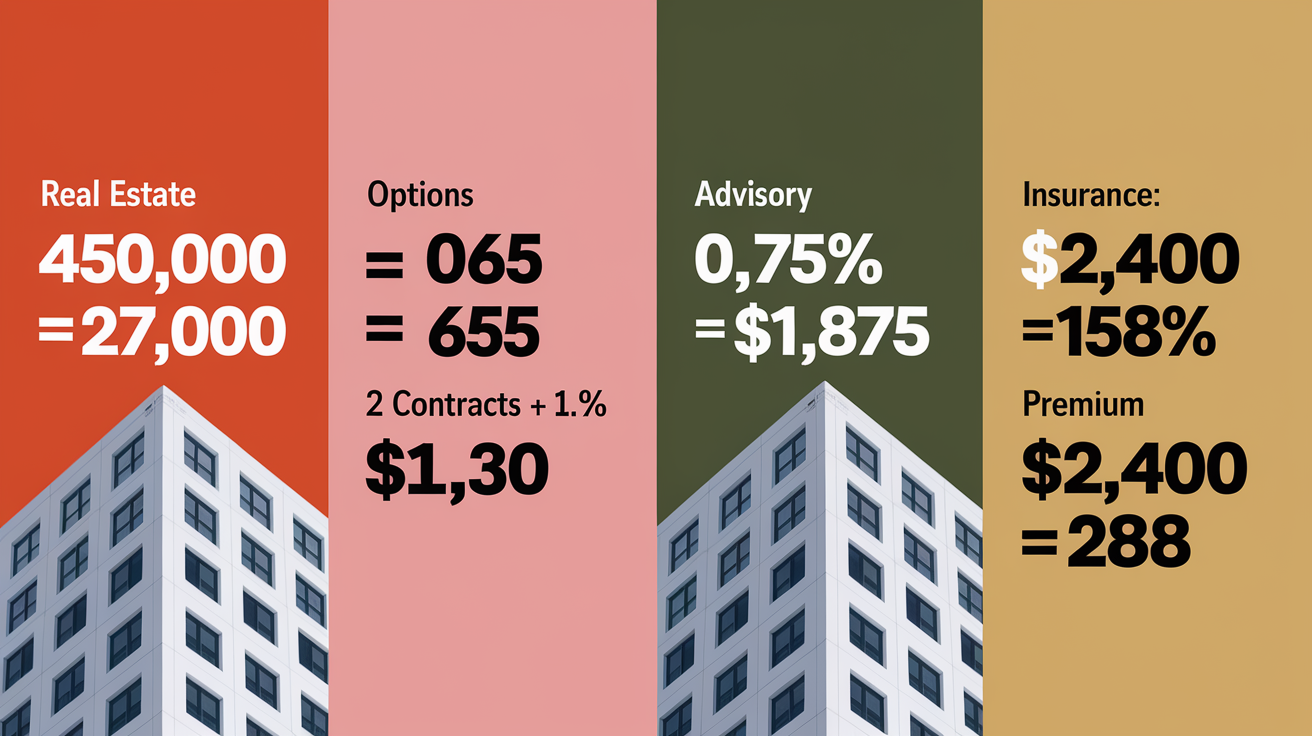
Real estate example: you sell a home for $450,000 with a 6 percent commission. Total commission is $27,000. Split 50/50, the listing side gets $13,500 and the buyer’s side gets $13,500. If your listing agent has a 60/40 split with the brokerage, the agent receives $8,100 and the brokerage keeps $5,400. Your net proceeds before other closing costs are $450,000 minus $27,000, or $423,000.
Options trading example: you buy two call option contracts at a premium of $1.50 each. The option value is 2 contracts × 100 shares × $1.50 = $300. Your broker charges $0.65 per contract, so the fee is 2 × $0.65 = $1.30. Total out-of-pocket is $300 + $1.30 = $301.30.
Advisory fee example: you have a $250,000 investment account and your advisor charges 0.75 percent annually. The annual fee is $250,000 × 0.0075 = $1,875, or about $156.25 per month. If the account grows to $300,000, the fee rises to $2,250 per year because the percentage applies to the new balance.
Insurance commission example: your annual homeowners premium is $2,400. The broker earns a 12 percent commission, so the broker receives $2,400 × 0.12 = $288 when the policy gets issued. You never write that check directly (the insurer pays the broker), but the $288 is built into your $2,400 premium.
| Scenario | Rate/Formula | Total Cost |
|---|---|---|
| Home sale $450,000 | 6% commission | $27,000 |
| 2 option contracts | $0.65 per contract | $1.30 |
| $250,000 advisory account | 0.75% AUM fee | $1,875/year ($156.25/month) |
| $2,400 insurance premium | 12% broker commission | $288 (paid by insurer) |
Negotiating Broker Fees and Reducing Total Costs Across Industries
Ask for a lower percentage when the transaction size is high or the market is competitive. Real estate sellers routinely negotiate commissions from 6 percent down to 4 or 5 percent, especially on homes above $500,000 where even a 1 percent cut saves thousands. Request AUM breakpoints from financial advisors. Many will tier their fee schedule if you ask, charging 1 percent on the first million and 0.75 percent above that. For options traders, high-volume discount brokers offer per-contract fees as low as $0.25 or even $0, so compare platforms and threaten to switch if your current broker won’t match.
Unbundle services to pay only for what you need. In real estate, flat-fee MLS listings let you handle showings and negotiation yourself while still reaching buyers through the multiple listing service. Fee-only financial advisors charge hourly rates or flat project fees instead of earning commissions on products, wiping out the conflict of interest that pushes you toward high-cost investments. For mortgages, shop at least three lenders and compare not just interest rates but also origination fees, points, and closing costs. Lenders often waive fees to win your business.
Negotiation strategies and cost-reduction tactics:
- Volume discounts – Ask brokers if per-trade or per-contract fees drop after you hit monthly thresholds. Some platforms cut rates in half for active traders.
- Fee caps – Request a maximum annual dollar fee instead of an open-ended percentage, especially useful for large AUM accounts.
- Limited-service or discount models – Use flat-fee real estate brokers, zero-commission stock platforms, or robo-advisors to cut intermediary costs by 50 to 90 percent.
- Switch to no-load funds – Avoid front-end and back-end mutual fund loads entirely by choosing index funds or ETFs with expense ratios below 0.25 percent.
- Negotiate agent splits – Experienced real estate agents can demand 80/20 or 90/10 splits with their brokerage, reducing the total commission you pay if you hire them as a for-sale-by-owner consultant at a flat fee.
Final Words
You saw the core fee types—percentage, flat, tiered, performance, hourly, and hybrid—and when fees usually trigger and who pays in real estate, trading, advisory, and insurance.
We showed sample calculations, flagged hidden costs like bid‑ask spread and platform fees, and gave negotiation moves: ask for lower splits, AUM breakpoints, or fee‑only advice.
If you’re asking how do broker fees and commissions work, start by identifying the model, the timing, and the dollar cost. Do that and you’ll keep more money while getting the service you need.
FAQ
Q: Will a realtor accept 2% commission?
A: A realtor will sometimes accept a 2% commission, but it’s well below the typical 5–6% and usually means limited service, less marketing, or special negotiation. Expect tradeoffs in exposure and agent effort.
Q: What does 12% broker fee mean?
A: A 12% broker fee means the broker takes 12% of the deal’s base amount as payment. Confirm what base it applies to, such as sale price, premium, or loan, because that changes your actual cost.
Q: How much does a mortgage broker make on a $500,000 loan?
A: A mortgage broker makes typically 0.5% to 2% on a $500,000 loan, so about $2,500 to $10,000. Exact pay depends on the origination fee, lender credits, or any upfront flat fees negotiated.
Q: How much does a realtor make off of a $300,000 house?
A: A realtor earns from the sale’s commission. On a $300,000 house at 6% total, that’s $18,000 split between agents, roughly $9,000 each before broker splits. After broker splits, an agent might net about $4,500 to $8,100.
