
What if one three-digit number quietly costs you thousands every year?
Credit scores do that.
This guide breaks down the five factors: payment history, amounts owed (credit utilization), length of history, credit mix, and new credit, and shows which actions actually raise your score.
You’ll get clear steps you can take today, realistic timelines, common traps to avoid, and easy monitoring tools to catch errors fast.
If you pay attention to payment history and keep balances low, small changes can move scores quickly.
How Credit Scores Work and the Factors That Influence Them

A credit score is a three-digit number that lenders use to guess whether you’ll pay them back. Scores run from 300 to 850. Higher is better.
Think of it like a financial report card. Years of borrowing behavior get squeezed into one number that banks, landlords, and sometimes even employers check before they decide to trust you with money or a lease.
Two models run the show: FICO and VantageScore. FICO’s been around longer and most lenders still use it. VantageScore launched in 2006, built by the three big credit bureaus. Early versions used weird ranges like 501 to 990, but versions 3.0 and 4.0 now match FICO’s 300 to 850 scale. Both pull data from your credit reports at Equifax, Experian, and TransUnion. But they weigh things differently. VantageScore can also count rent and phone bills, which FICO usually ignores.
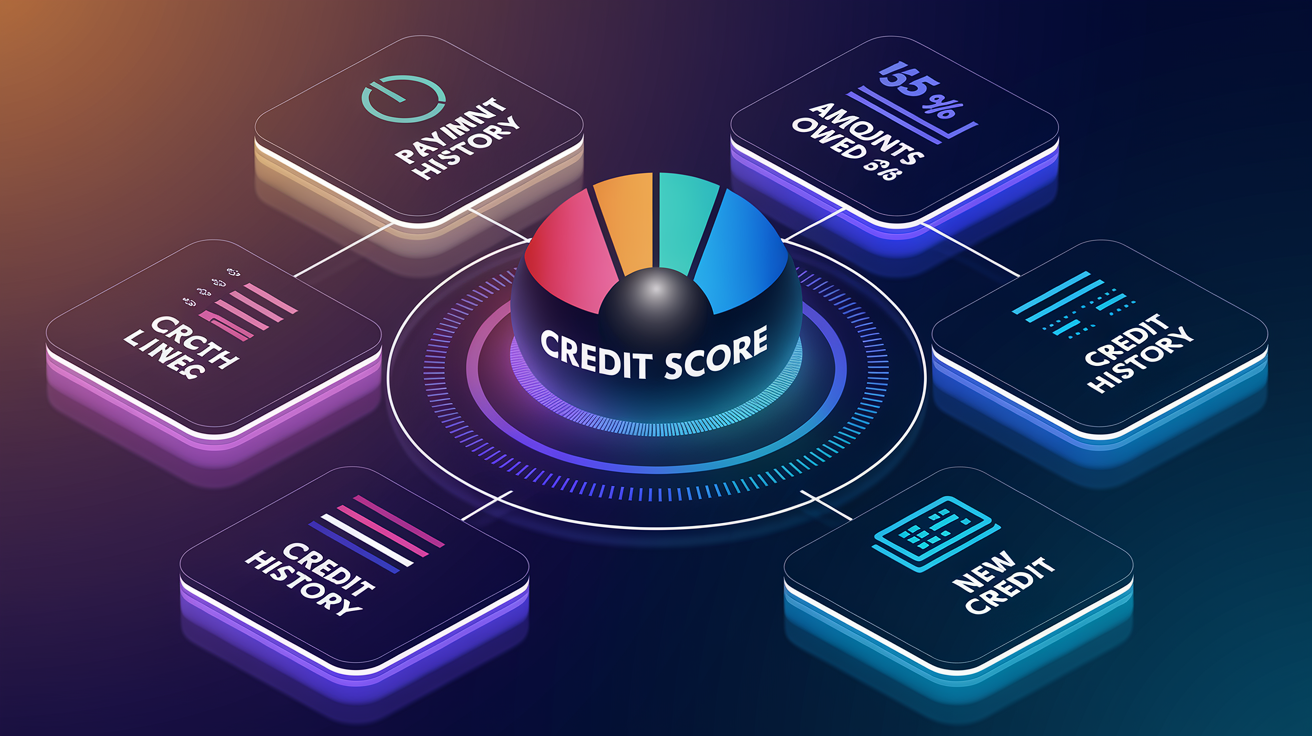
Both models split your behavior into five buckets. Here’s how FICO Score 8 breaks it down:
- Payment history: 35 percent
- Amounts owed (mostly credit utilization): 30 percent
- Length of credit history: 15 percent
- New credit: 10 percent
- Credit mix: 10 percent
Payment history and amounts owed eat up almost two thirds of your score. That’s why paying on time and keeping balances low matter more than anything else.
Detailed Breakdown of Each Credit Score Factor
Payment History
This is the big one. 35 percent of your score.
It tracks whether you pay bills on time. Credit cards, mortgages, car loans, student loans. All of it counts. One payment that’s 30 days late can stick around for seven years and tank your score fast. Bankruptcies and foreclosures hit even harder. Lenders look at payment history first because it answers their most important question: will you actually pay us back?
Amounts Owed
Worth 30 percent. This looks at how much debt you’re carrying right now.
The key piece here is credit utilization. That’s the percentage of your available credit you’re using. Say you’ve got two cards with a combined limit of 10,000 dollars and you’re carrying 4,000 dollars in balances. Your utilization is 40 percent. Most experts say keep it under 30 percent. Lower is better. High utilization makes you look stretched thin, even if you never miss a payment.
Card issuers usually report your balance on your statement closing date. So if you pay before that date, the reported number goes down.
Length of Credit History
This is 15 percent of your score. It considers your oldest account, your newest account, and the average age across everything.
Longer history gives lenders more data. Closing your oldest card can drop your average account age and cut your available credit. Both hurt. If an old card has no annual fee, keep it open. Use it for a small recurring charge every few months so it stays active.
Credit Mix
10 percent. This measures variety.
Lenders like seeing a mix of revolving credit (credit cards) and installment loans (mortgages, auto loans, student loans). It shows you can handle different repayment structures. But don’t open accounts you don’t need just to check a box. Strong payment history and low utilization matter way more.
New Credit
Also 10 percent. This tracks recent account openings and credit applications.
Each application triggers a hard inquiry, which can knock a few points off your score. Multiple inquiries in a short window look bad. It signals desperation or plans to pile on debt. Exception: when you’re rate shopping for a mortgage, auto loan, or student loan, newer scoring models treat multiple inquiries within 14 to 45 days as one inquiry. Hard inquiries stick around for two years but usually only hurt your score for the first 12 months.
Strategies to Improve Your Credit Score

Raising your score isn’t magic. It’s a series of actions that hit the factors that count most.
Set up autopay for at least the minimum on every account. Payment history is 35 percent. One missed payment can erase months of work. Autopay removes the risk of forgetting.
Pay down balances to get utilization under 30 percent. Single digits is even better. If you can’t pay everything off right away, tackle the highest balance first or make multiple payments during the month to lower the balance before your statement closes.
Keep old accounts open. Use them occasionally. Closing an old card cuts your available credit and can shorten your average account age. Both hurt. If the card has an annual fee, ask the issuer to downgrade it to a no-fee version instead of closing it.
Don’t apply for new credit unless you really need it. Each inquiry costs points. Opening several accounts fast can drop your score noticeably. If you’re shopping for a car or mortgage, do all your applications within that 14 to 45 day window so they count as one.
Check your credit reports from all three bureaus. Dispute errors immediately. Incorrect late payments, fraud, outdated info. Any of it can drag you down. Disputes usually get resolved in 30 days. Fixing even one mistake can boost your score.
Become an authorized user on someone’s account, but only if that account has a long history, low utilization, and perfect payment records. The account usually shows up on your report in one to two months and can give you an instant lift.
Consider a secured card or credit builder loan if you’re starting from scratch or rebuilding after a setback. They help you establish payment history. Many secured cards convert to unsecured after a year of on time payments.
Expected Timelines for Credit Score Improvements

Credit scores don’t change overnight. The timeline depends on what you’re fixing.
Dropping your utilization is the fastest move. Pay down a big balance and the change usually hits your report within one billing cycle, often 30 to 60 days. Since utilization is 30 percent of your score, a big drop in balances can jump your score 20 to 50 points or more depending on where you started.
Negative marks take way longer to fade. A late payment stays on your report for seven years. Its impact shrinks gradually as you stack up more on time payments. Bankruptcies can stick around for 10 years. The damage is worst in the first year or two. Consistent behavior after that slowly rebuilds things.
New inquiries affect your score for about 12 months, even though they stay visible for two years. Opening a new account temporarily lowers your average account age, but over six to 24 months that account becomes part of your positive history and can strengthen your profile.
Here are typical timelines:
- Paying down high balances: visible in one to two months
- Disputing and removing an error: 30 to 60 days after resolution
- Recovering from one late payment: noticeable improvement after 6 to 12 months of on time payments, full recovery over several years
- Hard inquiry impact: fades after 12 months, removed after 24 months
Common Mistakes That Damage Credit Scores

Lots of people hurt their scores without realizing it. Avoiding these mistakes is just as important as doing the right things.
The biggest mistake is maxing out cards or letting utilization climb above 30 percent. Even if you pay on time, high utilization signals stress and can drop your score by dozens of points.
Another common error is applying for too many accounts in a short stretch. Each inquiry shaves off points. Stack several together and lenders get nervous.
Closing old accounts is a trap. Many people think closing an unused card will help. It usually does the opposite. Closing a card cuts your total available credit, which raises utilization if you carry any balances. It can also shorten your average account age over time, especially once the closed account falls off your report.
Ignoring your credit reports is a mistake too. Errors, fraud, outdated info. All of it can sit there for months or years if you don’t check and dispute. And becoming an authorized user on a poorly managed account can backfire. If the primary cardholder misses payments or runs up balances, those negatives may land on your report and drag you down.
Tools and Methods for Monitoring Your Credit

You can’t improve what you don’t measure. Checking your reports and scores regularly helps you catch errors, track progress, and spot identity theft before it gets bad.
Start by pulling your credit reports from all three bureaus. Equifax, Experian, TransUnion. Federal law gives you one free report per year from each through the national credit reporting system. During COVID those reports became available weekly online, and some extensions may still apply. You can request by phone at 877-322-8228 or by mail at P.O. Box 105281, Atlanta, Georgia 30348-5281. Your report shows all your accounts, payment history, inquiries, and public records. But it doesn’t include your score.
To see your actual score, many banks, credit unions, and card issuers now offer free FICO or VantageScore access. Some monitoring services provide free scores plus alerts for new inquiries, account changes, or suspicious activity. Paid tools often add identity theft insurance, dark web scans, Social Security number monitoring. Free or paid, the key is checking regularly. At least every few months. And review all three bureaus, since they don’t always have the same info.
Real-World Examples of Credit Score Changes
Seeing how actions affect real scores makes this less abstract. Here are three scenarios.
A cardholder has two credit cards, each with a 5,000 dollar limit. They’re carrying a 4,000 dollar balance on each. Total utilization is 80 percent (8,000 dollars used out of 10,000 dollars available). After getting a tax refund, they pay one card down to 500 dollars. New utilization is 45 percent. Within one billing cycle, their score jumps about 35 points. A month later they pay the second card down to 1,000 dollars. Utilization drops to 15 percent. Score climbs another 20 points. Total gain: 55 points in roughly two months.
A borrower pulls their report and finds a late payment from two years ago they know they paid on time. They file a dispute with the bureau and send a bank statement as proof. The bureau investigates and removes the error in 30 days. Since payment history is 35 percent and the late payment was recent enough to still carry weight, removing it pushes the score up 48 points almost immediately.
A recent college grad applies for three credit cards, a car loan, and a personal loan over six weeks. Each application triggers a hard inquiry. Their score drops 4 points per inquiry, totaling a 20 point decline. They pause all new applications and focus on on time payments and low balances. After 12 months, the inquiries stop affecting their score and it recovers the lost points. By 24 months, the inquiries have aged enough that their impact is basically zero. Continued responsible behavior pushes the score 40 points above where it started.
Final Words
Start taking the steps now: you saw how credit scores are calculated (payment history, amounts owed, length of history, credit mix, new credit), what common mistakes hurt them, and quick wins like lowering utilization and fixing errors.
Use this guide to credit score factors and improvement strategies to order your next moves—check your report, pay on time, reduce balances, limit new applications, and dispute inaccuracies. Some changes show up in weeks; others take months.
Small, steady actions add up. You’ll see progress if you keep at it.
FAQ
Q: What is a credit score and how is it calculated?
A: The credit score is a three-digit number (300–850) calculated from your credit report data; models like FICO and VantageScore use payment history, balances, account age, mix, and recent activity.
Q: What are FICO and VantageScore and how do they differ?
A: FICO and VantageScore are competing credit models; FICO is older and widely used, while VantageScore weights factors differently and updates more frequently, so scores can differ for the same person.
Q: What are the main factors that affect my credit score?
A: The main factors that affect your score are payment history, amounts owed, length of credit history, credit mix, and new credit—each plays a specific role in the overall calculation.
Q: How much does each FICO factor weigh?
A: Under FICO, payment history is 35%, amounts owed 30%, length of credit history 15%, credit mix 10%, and new credit 10%, which together determine your 300–850 score.
Q: How does payment history affect my score?
A: Payment history affects your score by tracking on-time payments, late payments, delinquencies, and bankruptcies; consistent on-time payments build score, while serious delinquencies can lower it for years.
Q: How does credit utilization impact my score?
A: Credit utilization impacts your score by comparing revolving balances to credit limits; keeping utilization below about 30% usually helps, while higher utilization can drag your score down quickly.
Q: How long does it take to see credit score improvements?
A: Timeline depends on the action: utilization drops can show in weeks, error corrections may boost scores fast, but late payments remain on reports for seven years.
Q: What steps can I take right now to improve my credit score?
A: Immediate steps include paying bills on time, lowering card balances, disputing report errors, avoiding new credit applications, keeping old accounts open, and diversifying account types.
Q: What common mistakes hurt credit scores the most?
A: The most harmful mistakes are missed payments, high utilization, too many recent applications, closing old accounts, and ignoring your credit reports—these commonly lower scores.
Q: How can I monitor my credit and detect errors or fraud?
A: You can monitor credit by getting your free annual reports at AnnualCreditReport.com, using bank or app score updates, enabling alerts, and reviewing reports regularly for errors or theft.
Q: Can removing errors on my credit report raise my score?
A: Removing errors can raise your score because correcting misreported late payments or balances removes negative data; dispute inaccuracies with bureaus and creditors and follow up until resolved.
Q: What are real examples of actions that change credit scores?
A: Paying down a $3,000 balance on a $6,000 limit can raise scores quickly; removing a misreported late payment often gives a noticeable jump; reducing inquiries helps stabilize scores over months.
